
 Online Shop
 English
 China - 简体中文
 Global - English
 Brazil - Português
 Netherlands - Dutch
 Italy - Italiano
 Germany - Deutsch
 Spain - Español
 France - Français
 Vietnam - Tiếng Việt
 Poland - Polski
 Australia - English
 Japan - 日本語
Blog

Three-Phase String Inverters for Efficient, Flexible, and Reliable Commercial Solar Systems

Three-phase solar power systems require an inverter that can combine high conversion efficiency, stable grid interaction, broad operating flexibility, intelligent monitoring, and dependable protection. The SUN-3/4/5/6/7/8/9/10/12/15K-G06P3-EU-BM2-P1 three-phase string inverter is designed for this role. Covering rated power levels from 3 kW to 15 kW, the platform supports residential, commercial, agricultural, and small industrial photovoltaic installations that use three-phase electrical distribution.
This inverter family is built around two maximum power point tracking channels, a maximum PV input voltage of 1,100 V, a wide MPPT operating range, natural cooling, IP65 protection, and a range of grid-support and energy-management functions. Its design allows system planners to match different models to different array sizes while maintaining a consistent installation approach across a project portfolio.
The product is manufactured by Ningbo Deye Inverter Technology Co., Ltd., a technology manufacturing enterprise with activities covering research and development, design, production, sales, and service. The company has developed a broad product portfolio that includes string inverters, energy storage inverters, microinverters, energy storage systems, and related digital energy-management solutions. This wider engineering background supports the development of grid-connected inverter products that must operate safely and consistently in changing electrical and environmental conditions.
Product Overview
The SUN-3/4/5/6/7/8/9/10/12/15K-G06P3-EU-BM2-P1 is a three-phase string inverter series for photovoltaic systems connected to low-voltage three-phase grids. The series includes ten rated power options: 3 kW, 4 kW, 5 kW, 6 kW, 7 kW, 8 kW, 9 kW, 10 kW, 12 kW, and 15 kW.
Each model converts direct current from PV modules into three-phase alternating current for local consumption, grid export, or zero-export operation. The family uses a non-isolated topology and is equipped with protection functions intended to support safe and dependable operation in modern PV installations.
The core product characteristics include two MPP trackers, maximum efficiency as high as 98.5%, optional string intelligent monitoring, wide output-voltage compatibility, optional anti-PID functionality, and support for zero-export and virtual synchronous generator applications. These functions allow the inverter to serve more than a basic energy-conversion role. It can also participate in system control, monitoring, and grid-support strategies.
| Product characteristic | Specification or capability |
| Product type | Three-phase string inverter |
| Rated power range | 3 kW to 15 kW |
| Maximum PV input voltage | 1,100 V |
| MPPT voltage range | 120 V to 1,000 V |
| Number of MPP trackers | 2 |
| Maximum efficiency | Up to 98.5% |
| Grid connection | 3L/N/PE |
| Output voltage | 220/380 V or 230/400 V |
| Ingress protection | IP65 |
| Cooling method | Natural cooling |
| Communication interfaces | RS485 and RS232 |
| Optional monitoring methods | GPRS, Wi-Fi, Bluetooth, 4G, and LAN |
| Warranty | 5 years |
Power Options for Project Flexibility
A major advantage of a product family is the ability to select the appropriate inverter size without changing the overall system architecture. The 3 kW and 4 kW versions can be used in smaller three-phase buildings, workshops, farms, and mixed-use properties. The 5 kW to 10 kW models are suitable for larger homes, small businesses, retail buildings, offices, and light commercial facilities. The 12 kW and 15 kW versions provide additional capacity for larger commercial rooftops and distributed generation systems.
The maximum recommended PV input power varies by model. The 3 kW unit accepts up to 4.5 kW of PV input power, while the 15 kW version accepts up to 22.5 kW. This DC-to-AC sizing approach can improve annual energy production because the PV array can continue producing useful power during lower-irradiance periods when the inverter is not operating at its full AC rating.
| Model rating | Maximum PV input power | Rated AC output power | Maximum AC apparent power |
| SUN-3K-G06P3-EU-BM2-P1 | 4.5 kW | 3 kW | 3.3 kVA |
| SUN-4K-G06P3-EU-BM2-P1 | 6 kW | 4 kW | 4.4 kVA |
| SUN-5K-G06P3-EU-BM2-P1 | 7.5 kW | 5 kW | 5.5 kVA |
| SUN-6K-G06P3-EU-BM2-P1 | 9 kW | 6 kW | 6.6 kVA |
| SUN-7K-G06P3-EU-BM2-P1 | 10.5 kW | 7 kW | 7.7 kVA |
| SUN-8K-G06P3-EU-BM2-P1 | 12 kW | 8 kW | 8.8 kVA |
| SUN-9K-G06P3-EU-BM2-P1 | 13.5 kW | 9 kW | 9.9 kVA |
| SUN-10K-G06P3-EU-BM2-P1 | 15 kW | 10 kW | 11 kVA |
| SUN-12K-G06P3-EU-BM2-P1 | 18 kW | 12 kW | 13.2 kVA |
| SUN-15K-G06P3-EU-BM2-P1 | 22.5 kW | 15 kW | 16.5 kVA |
Using a common platform across several power levels can simplify engineering documentation, installer training, spare-parts planning, and maintenance procedures. It also helps distributors and EPC contractors build standardized packages for different customer segments.
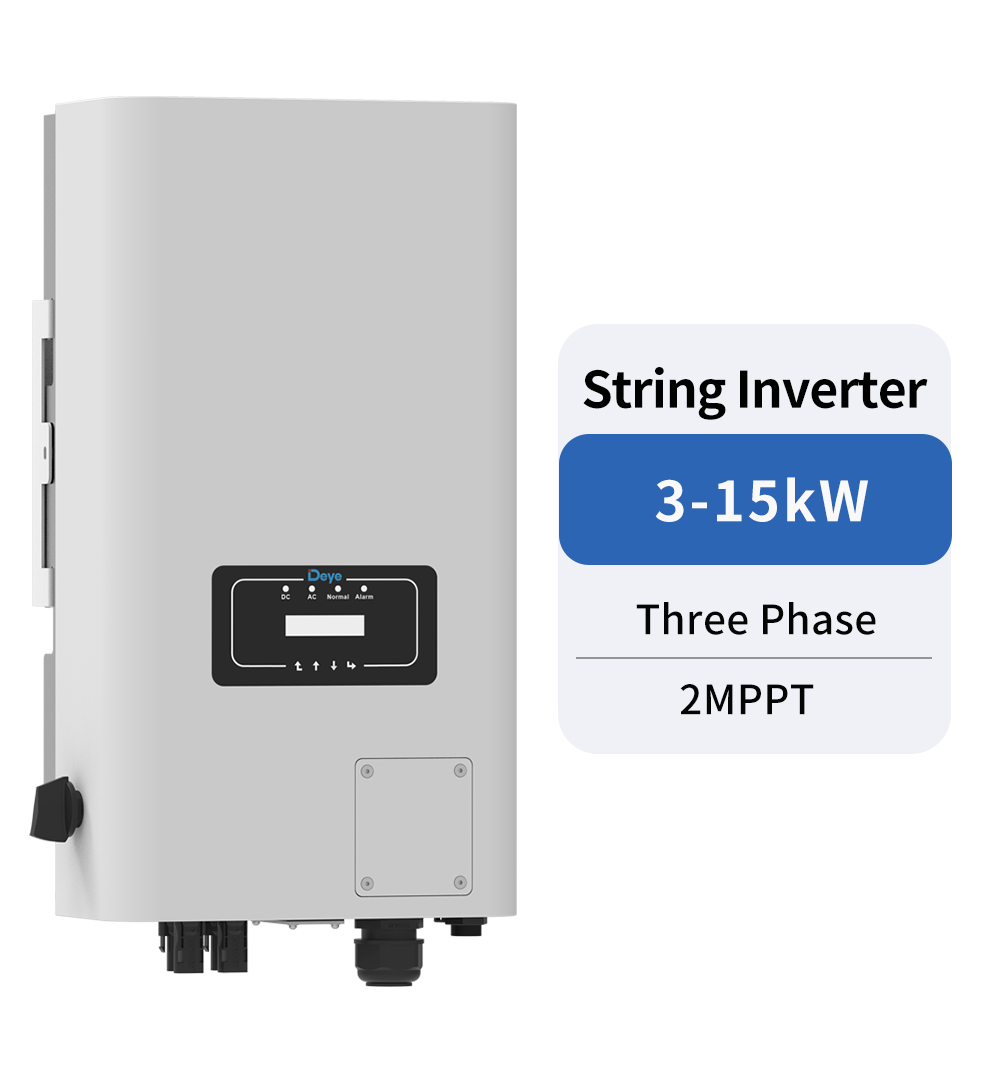
SUN-3/4/5/6/7/8/9/10/12/15K-G06P3-EU-BM2-P1
Two MPPT Channels and Better Array Design
The inverter has two independent maximum power point trackers. MPPT technology continuously adjusts the operating point of a PV array to obtain the highest practical energy yield under changing irradiance and temperature conditions. Two trackers are particularly valuable when a roof has different orientations, different tilt angles, partial shading, or unequal string lengths.
For the 3 kW through 10 kW models, the published input arrangement is two MPP trackers with one string per tracker. The 12 kW and 15 kW versions provide two MPP trackers with a 1+2 string arrangement. This gives designers additional flexibility when connecting larger arrays, subject to the current, voltage, module, and local electrical requirements of the final installation.
The maximum PV input voltage is 1,100 V, while the MPPT voltage range extends from 120 V to 1,000 V. The startup voltage is 140 V, and the rated PV input voltage is 600 V. This broad voltage window supports a wide variety of module combinations and string designs. Engineers can configure strings for appropriate cold-weather open-circuit voltage and hot-weather operating voltage without being restricted to a narrow operating band.
Proper string design remains essential. The maximum voltage of the selected modules must remain below the inverter’s permitted voltage under the lowest expected site temperature. The operating voltage should remain within the MPPT range during normal conditions. Designers should also confirm that the string current does not exceed the applicable operating-current and short-circuit-current limits of the selected model.
Input Current Capability
The inverter platform offers maximum operating PV input current values of 20+20 A for the applicable models and 20+26 A for the higher-capacity models. The corresponding maximum input short-circuit current values are 30+30 A and 30+39 A. These values are important for compatibility with modern high-current PV modules, especially when bifacial modules or large-format modules are used.
Compared with older inverter platforms designed around lower-current modules, this input capability can reduce the need for restrictive module selection. It gives installers more freedom to use current-generation modules, while still requiring a complete compatibility check based on the module datasheet and the final string configuration.
High Conversion Efficiency and Energy Yield
Conversion efficiency directly affects the amount of solar energy delivered to the building or grid. The series reaches a maximum efficiency of up to 98.5%, with model-dependent values ranging from 98.1% to 98.5%. Euro efficiency ranges from 97.5% to 98.0%, and MPPT efficiency is specified at greater than 99%.
Maximum efficiency describes the best conversion point under defined test conditions. Euro efficiency provides a more representative weighted performance value across different operating loads. MPPT efficiency indicates how effectively the inverter tracks the best operating point of the PV array. Considering all three figures gives a more complete view of practical performance.
High efficiency provides several potential benefits. More of the PV array’s energy becomes usable AC energy, less energy is dissipated as heat, and the inverter can operate with a lower thermal burden at equivalent output. Over a multi-year operating life, even small efficiency differences can become meaningful, particularly in high-production commercial installations.
The inverter’s natural-cooling design also supports efficient operation by avoiding the electrical consumption and maintenance requirements associated with active fans. Natural cooling must be considered together with the installation environment, clearances, solar exposure, and ambient temperature. The specified operating temperature range is -25°C to +60°C, with derating above 45°C. Appropriate ventilation and shading of the inverter remain important for maintaining output during hot weather.
Three-Phase Grid Compatibility
The inverter is designed for a three-phase connection using 3L/N/PE. It supports 220/380 V and 230/400 V nominal grid systems, with an output-voltage range of 0.85Un to 1.1Un. The rated grid-frequency options are 50 Hz and 60 Hz, with operating ranges of 45 to 55 Hz and 55 to 65 Hz respectively.
Three-phase power conversion can help distribute solar generation across the phases of a building’s electrical network. It is well suited to facilities with three-phase motors, heat pumps, commercial refrigeration, agricultural equipment, workshops, and other balanced or variable loads. The product’s power ratings allow system planners to select an inverter that corresponds to the site’s PV capacity and grid-connection limit.
The inverter provides a power-factor adjustment range from 0.8 leading to 0.8 lagging. This capability can support grid-management requirements and reactive-power control strategies, although the exact operating mode must be configured according to local utility rules and the project’s interconnection agreement.
Total current harmonic distortion is specified at less than 3%, and DC injection current is specified at less than 0.5% of rated current. Low distortion helps maintain power quality and reduces the possibility of unwanted interaction with sensitive loads or other electrical equipment.
Zero Export and Virtual Synchronous Generator Applications
Many commercial and residential users want to maximize self-consumption without sending surplus electricity to the public grid. The inverter supports zero-export applications when combined with the appropriate meter, sensor, and control configuration. In such a system, the inverter adjusts its output so that local loads can consume available solar power while grid export is limited or prevented.
Zero-export control can be valuable in locations where export approval is difficult, export compensation is unattractive, or the building owner wants to reduce grid purchases without changing the existing grid-connection arrangement. It can also assist facilities that have strict power-flow limits at the point of common coupling.
The inverter also supports VSG, or virtual synchronous generator, applications. VSG control is intended to make power-electronic equipment behave in selected ways that resemble some characteristics of traditional synchronous generation, such as controlled responses to changes in grid conditions. The actual function available in a project depends on system configuration, firmware, local grid requirements, and any additional control equipment.
These functions demonstrate that the inverter is not limited to simple maximum-power conversion. It can participate in more advanced distributed-energy architectures, especially where self-consumption, power quality, and grid-support functions are important.
Safety and Protection Architecture
Safety is a fundamental consideration in PV system design. The product includes multiple protection and monitoring features on both the DC and AC sides. These features are intended to detect abnormal conditions, reduce equipment stress, and help protect personnel and connected electrical assets.
| Protection or monitoring function | Availability |
| DC reverse-polarity protection | Yes |
| AC output overcurrent protection | Yes |
| AC output overvoltage protection | Yes |
| AC output short-circuit protection | Yes |
| Thermal protection | Yes |
| Insulation impedance detection | Yes |
| DC component monitoring | Yes |
| Anti-islanding protection | Yes |
| Residual-current detection | Yes |
| DC and AC surge protection | Type II DC and Type II AC |
| DC switch | Yes |
| Arc-fault circuit interrupter | Optional |
Anti-islanding protection is essential for grid-connected inverters. If the utility grid is disconnected, the inverter must stop energizing the relevant circuit in accordance with applicable standards and grid rules. Insulation monitoring and residual-current detection provide additional layers of protection against leakage and abnormal grounding conditions.
Type II surge protection on the DC and AC sides helps protect the inverter from transient overvoltage events. Surge protection does not replace a complete site-level lightning and surge-protection design, but it provides an integrated protective function within the inverter.
An optional AFCI function can be selected where the project requires arc-fault detection and interruption. Arc-fault protection may be especially relevant for larger rooftop arrays, buildings with particular fire-safety requirements, or markets that specify this capability.
Thermal Design, Enclosure Protection, and Outdoor Use
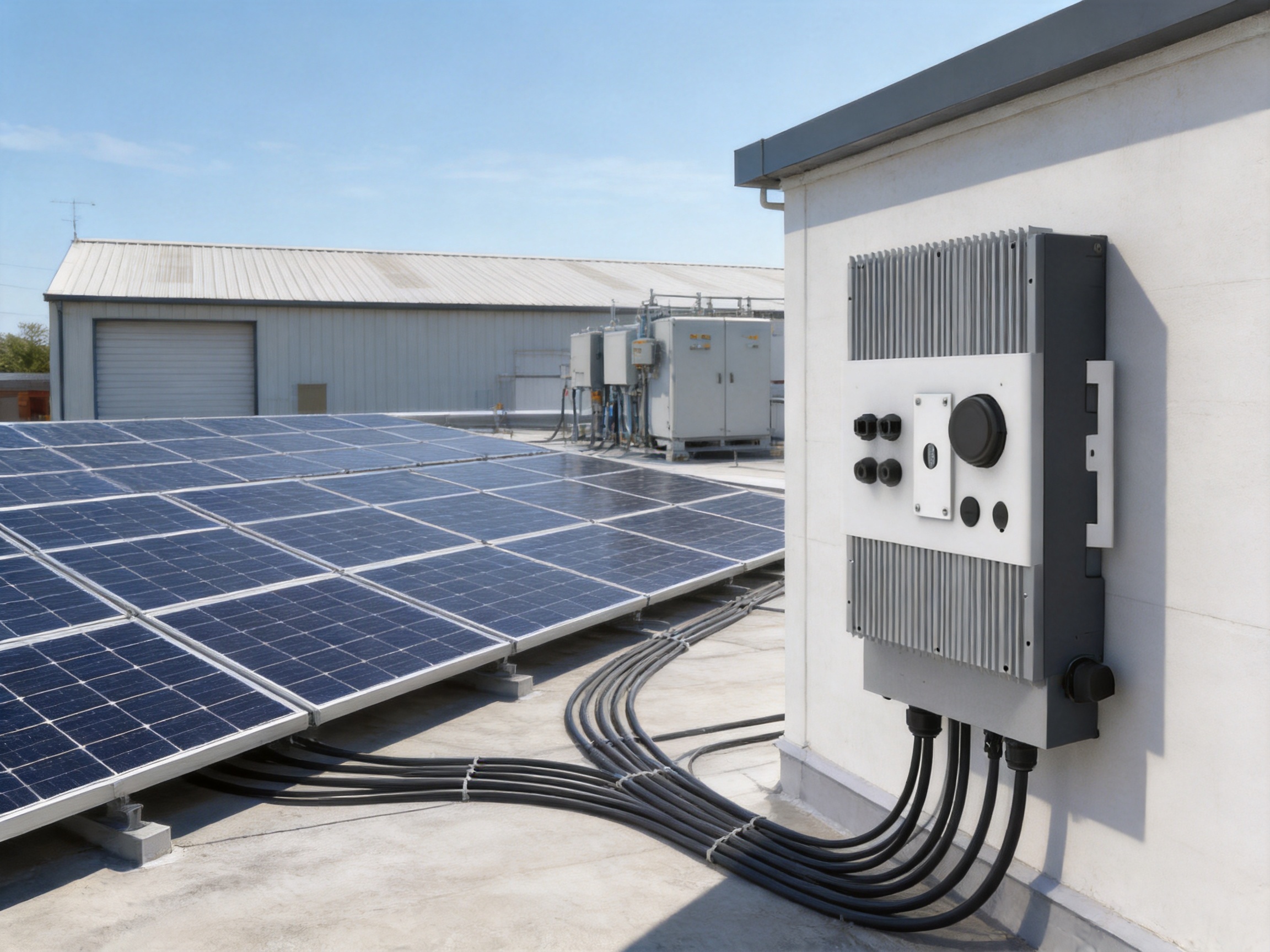
The inverter uses natural cooling and has an IP65 enclosure rating. Natural cooling reduces moving parts, acoustic output, and fan-related service requirements. The specified noise level is below 45 dB, making the unit suitable for many locations near occupied buildings when local installation rules are followed.
IP65 protection indicates that the enclosure is designed to resist dust ingress and water jets under standardized test conditions. The inverter can therefore be used in outdoor installations, but it should still be mounted in a suitable location. Direct exposure to continuous sunlight can increase internal temperature, while standing water, chemical vapors, excessive dust, and poor air circulation can shorten service life.
The operating temperature range is -25°C to +60°C, with derating above 45°C. Derating means the inverter may reduce its maximum power output as the ambient temperature rises. This is a normal thermal-management strategy. Project designers should consider local climate, wall orientation, mounting height, spacing between units, and the potential temperature of the mounting surface.
The standard cabinet dimensions are approximately 283 × 525 × 178 mm for the smaller configuration, excluding connectors and brackets. The other configuration is approximately 283 × 525 × 188 mm. Weights are approximately 11.5 kg and 12 kg respectively. These dimensions and weights can simplify handling and wall mounting compared with larger central or high-capacity commercial inverter equipment.
Monitoring and Communication
The inverter includes RS485 and RS232 communication interfaces. Optional monitoring methods include GPRS, Wi-Fi, Bluetooth, 4G, and LAN. This range of communication options allows the product to be adapted to different project environments and user preferences.
For a small residential system, Wi-Fi or Bluetooth may provide convenient local commissioning and routine monitoring. For a commercial site, LAN, 4G, or RS485 may be more suitable where a stable communications connection, centralized data collection, or integration with an energy-management system is required. GPRS may remain useful in locations where legacy cellular coverage is available and other communication options are impractical.
String intelligent monitoring is available as an option. String-level information can help identify underperforming strings, wiring problems, module mismatch, shading, or abnormal current behavior. Without string-level data, a fault may only become visible as a reduction in total inverter output. With more detailed monitoring, maintenance teams can narrow the problem area and reduce diagnostic time.
Monitoring should be viewed as an operational tool rather than merely a display function. Historical data can assist with performance verification, preventive maintenance, warranty assessment, and comparison of expected and actual production. It can also help operators identify gradual degradation before it becomes a major production loss.
Manufacturing Strength and Engineering Capability
The performance of a solar inverter depends not only on its circuit design but also on the quality of its manufacturing process. A reliable inverter requires consistent electronic assembly, controlled thermal interfaces, accurate sensor calibration, high-quality enclosure construction, dependable connectors, and software that is tested against the hardware platform.
Ningbo Deye Inverter Technology Co., Ltd. operates as an integrated technology manufacturer with capabilities spanning research and development, product design, production, sales, and service. This vertical coordination can support faster communication between engineering and manufacturing teams. It also allows product feedback from installers, distributors, and end users to influence future design and service improvements.
The company’s broader product portfolio includes PV string inverters, microinverters, energy storage inverters, modular commercial and industrial energy storage systems, all-in-one energy storage systems, and related energy-management technologies. Working across these product categories requires knowledge of power semiconductors, high-frequency conversion, battery interfaces, grid synchronization, communications, thermal management, and system-level protection.
That experience is relevant to a three-phase string inverter because modern PV systems increasingly operate as part of integrated energy systems. A grid-tied inverter may need to coordinate with smart meters, energy-management systems, storage equipment, EV chargers, backup equipment, and utility-control requirements. A manufacturer with experience across these areas can design products with broader compatibility and a clearer path toward future system integration.
Controlled Electronic Assembly
Electronic manufacturing quality depends on repeatable processes. Printed circuit board assembly generally requires controlled component placement, soldering, inspection, and functional testing. Automated assembly can help improve consistency, while optical or electrical inspection can identify defects that are difficult to detect through visual examination alone.
For power-conversion equipment, manufacturing controls are especially important because the product handles high DC voltages and three-phase AC output. Power semiconductors, capacitors, inductors, relays, sensors, and protective components must be installed with correct orientation, torque, spacing, and thermal contact. Production testing should verify that each unit responds correctly under expected operating and protection conditions.
Although individual factory process details may vary by production line and model, an advanced inverter manufacturing system normally includes incoming-material inspection, controlled assembly, software and firmware loading, calibration, electrical safety testing, functional verification, and final quality inspection. These stages help create traceability from components to finished products.
Thermal and Mechanical Reliability
Thermal design is closely connected to manufacturing quality. Heat-generating components require correct mounting pressure and suitable thermal-interface materials. Enclosures must maintain structural integrity and sealing performance. Connectors must be correctly installed to prevent loose contacts, excessive resistance, or moisture ingress.
The use of natural cooling places particular importance on mechanical layout and heat dissipation. Internal components must be arranged so that heat can move toward the enclosure and away from sensitive control electronics. The production process must preserve the intended clearances, fastener torque, sealing surfaces, and thermal paths.
The IP65 enclosure, compact dimensions, and low noise specification indicate a design aimed at outdoor distributed applications. Reliable production of these characteristics requires more than selecting an enclosure with a stated rating. Gaskets, cable entries, covers, connectors, and assembly procedures must work together to maintain protection after installation and throughout normal service.
Testing and Compliance-Oriented Design
The product documentation lists grid regulations and safety and electromagnetic compatibility standards that include IEC 61727, IEC 62116, CEI 0-21, EN 50549, NRS 097, RD 140, UNE 217002, OVE-Richtlinie R25, G98, G99, and VDE-AR-N 4105. It also lists IEC and EN 61000-6-1/2/3/4, IEC and EN 62109-1, and IEC and EN 62109-2 for safety and EMC considerations.
Compliance-oriented engineering requires evaluation of electrical safety, electromagnetic emissions, immunity, grid behavior, anti-islanding response, insulation, temperature, and mechanical conditions. A manufacturer serving multiple international markets must manage different grid codes and certification expectations while maintaining a consistent hardware platform.
The listed certificates and declarations include documents related to IEC 62109, EMC, grid connection, Spanish requirements, German requirements, French requirements, and other European standards. These documents provide evidence that the product family has been evaluated against relevant technical requirements. Project developers should always confirm that the exact model, firmware version, and local approval status match the requirements of the target market.
Advantages Compared with Conventional Alternatives
The inverter offers several advantages when compared with conventional single-MPPT, lower-voltage, fan-cooled, or narrowly configured string inverter platforms. These advantages do not eliminate the need for project-specific design, but they can improve flexibility and reduce installation complexity.
Two Independent MPPTs
Two MPPT channels provide more design freedom than a single tracker. Separate roof orientations can be assigned to separate trackers, reducing the impact of different irradiance patterns. This can be useful on buildings with east-west roofs, dormers, rooftop equipment, or partial shading.
High PV Voltage Capability
A maximum PV input voltage of 1,100 V supports longer strings than many older low-voltage inverter designs. Longer strings can reduce the number of parallel circuits, simplify cable routing, and potentially reduce DC cable losses and balance-of-system costs. String length must still be calculated using module open-circuit voltage at the lowest expected temperature.
Broad Model Range
The 3 kW to 15 kW range allows the same product family to address different site sizes. This can be more efficient than combining multiple unrelated inverter platforms. Installers can use familiar commissioning procedures, while distributors can manage a coherent inventory of products and accessories.
High Efficiency
Maximum efficiency up to 98.5% and MPPT efficiency above 99% support strong energy conversion performance. When combined with a correctly sized PV array, high efficiency can increase annual usable output and reduce conversion losses.
Natural Cooling
Natural cooling can provide a quieter operating environment and reduce the number of moving parts. Fan-cooled inverters may be advantageous in some high-temperature or high-power applications, but a naturally cooled unit can be attractive for distributed systems where low noise and reduced fan maintenance are priorities.
Integrated Protection
The combination of reverse-polarity protection, overcurrent protection, overvoltage protection, insulation detection, anti-islanding protection, residual-current detection, surge protection, and a DC switch provides a comprehensive protective foundation. Optional AFCI and string monitoring further extend the system’s safety and diagnostic capabilities.
Grid and Energy-Management Functions
Zero-export support, power-factor adjustment, and VSG application capability make the inverter suitable for projects that require more advanced control than simple grid export. This can improve its usefulness in markets with export limits, reactive-power requirements, or evolving grid-support expectations.
Applications
Residential Three-Phase Systems
Three-phase homes and rural properties may have substantial loads such as heat pumps, water pumps, workshops, agricultural equipment, and EV chargers. A three-phase inverter can connect directly to the property’s distribution system and provide solar energy across the phases.
The smaller models can support moderate household PV systems, while the 7 kW to 15 kW versions can serve larger homes or properties with extensive roof area. Zero-export operation may be useful where local regulations limit energy export or where the homeowner prioritizes self-consumption.
Small Commercial Buildings
Retail stores, offices, clinics, restaurants, warehouses, and service facilities often have daytime electrical demand that aligns well with PV production. The inverter can convert rooftop solar generation for direct consumption while supporting monitoring and optional string diagnostics.
The 6 kW to 15 kW models can be selected according to roof capacity, local load profile, and grid-connection conditions. Multiple units may be used for larger systems, provided that the electrical design accounts for phase balance, protection, communications, fault coordination, and applicable grid requirements.
Agricultural and Rural Installations
Farms and rural businesses frequently use three-phase pumps, ventilation systems, refrigeration, lighting, and processing equipment. The wide input-voltage range and outdoor enclosure make the product suitable for many distributed agricultural projects when the installation environment is properly assessed.
In agricultural areas, designers should pay attention to dust, humidity, corrosive substances, lightning exposure, cable lengths, and communication availability. Optional 4G, GPRS, or LAN communication can help maintain visibility when the inverter is installed away from the main building.
Small Industrial Systems
Workshops and light-industrial buildings can use the inverter to reduce daytime electricity purchases. The power-factor adjustment range and low harmonic-distortion specification can support sites with varied electrical loads, although the complete electrical network should be evaluated before installation.
Installation and System-Design Considerations
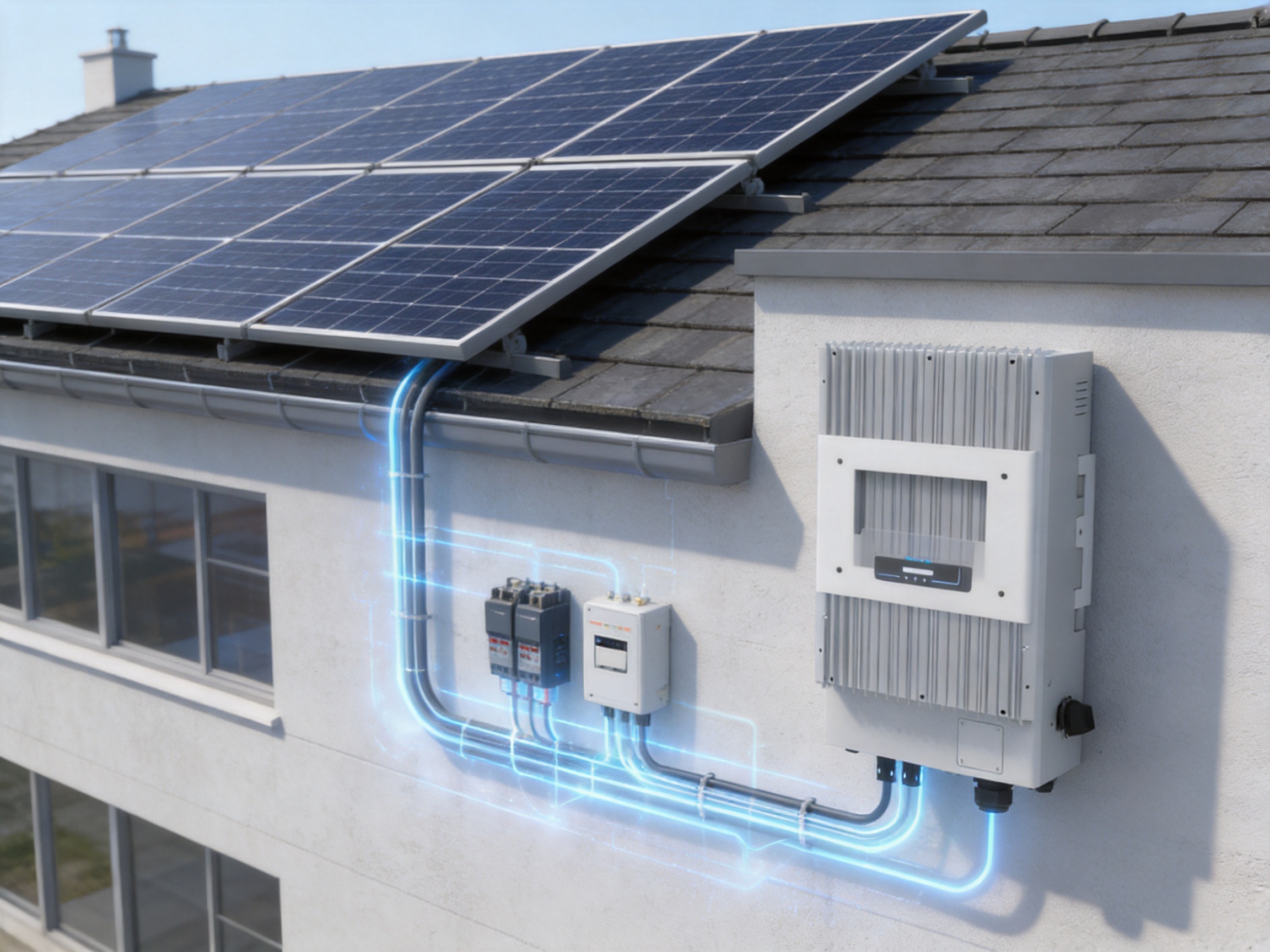
The inverter should be installed by qualified personnel in accordance with local electrical codes, utility requirements, and the manufacturer’s installation instructions. PV strings must be checked for polarity, open-circuit voltage, operating voltage, current, insulation, and connector compatibility before connection.
Designers should calculate the highest possible string voltage under the site’s minimum temperature. The result must remain below the maximum PV input voltage. They should also calculate expected operating voltage at high module temperature and confirm that it remains within the MPPT range.
AC cable sizing must account for rated current, maximum output current, cable length, installation method, ambient temperature, voltage drop, and local code. The published rated and maximum AC currents differ by model and voltage configuration, so the final protective-device selection should be based on the applicable electrical design rather than a generalized rule.
Appropriate external protection may include AC circuit breakers, residual-current devices where required, DC protection, additional surge protective devices, and a suitable earthing system. The integrated functions of the inverter are important, but they do not replace site-level protection, isolation, lightning protection, or correct grounding.
Installers should maintain clearances around the inverter, avoid mounting it in direct afternoon sunlight where possible, and prevent exposure to standing water or corrosive vapors. Multiple inverters should not be mounted so closely together that heat from one unit raises the operating temperature of another.
Operation, Maintenance, and Service Life
Routine maintenance for a naturally cooled IP65 inverter is generally straightforward, but the product should still be inspected periodically. Maintenance teams can check the enclosure, connectors, cable glands, mounting hardware, warning labels, communication equipment, and surrounding ventilation space.
Dust accumulation should be assessed according to the installation environment. The enclosure should not be opened by unauthorized personnel, and cleaning should be performed using methods that do not force water or contaminants into connectors or ventilation areas. Any alarm or fault code should be investigated using the approved service procedure.
Monitoring data can support preventive maintenance. A gradual reduction in string current may indicate shading, soiling, module degradation, connector problems, or a developing insulation issue. Unexpected voltage behavior may indicate string configuration problems or module damage. Comparing similar strings and reviewing historical production can help identify abnormal performance.
The published warranty period is five years. Warranty coverage normally depends on proper installation, operation within the stated electrical and environmental limits, and compliance with the applicable warranty terms. Owners should retain commissioning records, serial-number information, test results, and maintenance documentation.
Why the Product Family Is Attractive to Installers and Distributors
Installers often value products that combine technical capability with practical deployment advantages. The series offers a consistent model structure, multiple power ratings, compact dimensions, communication options, and a broad set of protection functions. These characteristics can simplify product selection and reduce the learning curve for installation teams.
Distributors can benefit from stocking a coherent range rather than unrelated products with different accessories, software, and commissioning procedures. The common platform can make it easier to prepare sales materials, training sessions, design templates, and replacement strategies.
For EPC contractors, the combination of two MPPTs, 1,100 V maximum PV input, optional string monitoring, and multiple grid-code references can make the product suitable for a range of project specifications. The ability to use the same family across small and medium distributed systems may also improve procurement efficiency.
For system owners, the most important benefits are likely to be energy yield, operational visibility, protection, grid compatibility, and long-term serviceability. A product that is easy to monitor and maintain can reduce uncertainty after commissioning and provide better information for future system expansion or troubleshooting.
Manufacturing and Corporate Scale
Ningbo Deye Inverter Technology Co., Ltd. was founded in 2000 and has developed from a manufacturing and technology business into a diversified provider of PV, energy-storage, and environmental-appliance products. The company was listed on the Shanghai Stock Exchange in April 2021. Its products are sold in more than 140 countries and regions, demonstrating experience with international distribution and varied regulatory environments.
The company’s inverter portfolio includes string inverters from 1 kW to 136 kW, energy-storage inverters from 3 kW to 80 kW, and microinverters from 300 W to 2.2 kW. Its broader solutions include residential all-in-one energy storage, commercial and industrial battery cabinets, modular energy storage, PV-battery-EV charging integration, utility-scale liquid-cooled energy storage, and digital energy-management systems.
Such product breadth can strengthen manufacturing and engineering knowledge in several ways. High-volume product families encourage process standardization. Different product categories provide opportunities to refine power-electronics designs, thermal solutions, communications platforms, and protection strategies. International market experience encourages attention to documentation, certification, quality consistency, and after-sales support.
The company’s stated focus on research, design, production, sales, and service creates an integrated business model. For customers, this may provide a clearer support structure than purchasing a product from a company that only assembles or distributes equipment. The practical value depends on regional service coverage and the specific support agreement, but the underlying organization provides a strong foundation for global product delivery.
Environmental and Sustainability Considerations
Solar inverters contribute to sustainability by enabling renewable electricity generation, but their own design and operating life also matter. High conversion efficiency helps reduce energy losses. Natural cooling can reduce auxiliary consumption and avoid fan replacement during normal service. A compact enclosure can reduce shipping volume and simplify installation logistics.
Long-term reliability is another sustainability factor. An inverter that remains operational for many years avoids premature replacement, reduces electronic waste, and preserves the energy and materials invested in manufacturing. Proper installation, thermal management, surge protection, and preventive maintenance are therefore important not only for financial performance but also for environmental performance.
At the end of service life, electronic equipment should be handled according to local waste-electrical-and-electronic-equipment requirements. Owners and installers should consult authorized service channels and local recycling systems for disposal or component recovery.
Technical Summary
| Parameter | Published value |
| Rated output power | 3 kW, 4 kW, 5 kW, 6 kW, 7 kW, 8 kW, 9 kW, 10 kW, 12 kW, or 15 kW |
| Maximum PV input power | 4.5 kW to 22.5 kW depending on model |
| Maximum PV input voltage | 1,100 V |
| Startup voltage | 140 V |
| MPPT voltage range | 120 V to 1,000 V |
| Rated PV input voltage | 600 V |
| MPP trackers | 2 |
| Maximum operating PV current | 20+20 A or 20+26 A depending on model group |
| Maximum input short-circuit current | 30+30 A or 30+39 A depending on model group |
| Maximum AC apparent power | 3.3 kVA to 16.5 kVA |
| Nominal grid voltage | 220/380 V or 230/400 V |
| Grid connection | 3L/N/PE |
| Frequency | 50 Hz or 60 Hz |
| Power factor range | 0.8 leading to 0.8 lagging |
| Total current harmonic distortion | Less than 3% |
| Maximum efficiency | 98.1% to 98.5% depending on model |
| MPPT efficiency | Greater than 99% |
| Operating temperature | -25°C to +60°C, with derating above 45°C |
| Ambient humidity | 0% to 100% |
| Maximum permissible altitude | 4,000 m |
| Noise | Less than 45 dB |
| Ingress protection | IP65 |
| Topology | Non-isolated |
| Cooling | Natural cooling |
| Warranty | 5 years |
Q&A
What type of solar inverter is this product?
It is a three-phase string inverter for grid-connected photovoltaic systems. It converts DC electricity from PV strings into three-phase AC electricity for building consumption or grid export.
What power ratings are available?
The series includes 3 kW, 4 kW, 5 kW, 6 kW, 7 kW, 8 kW, 9 kW, 10 kW, 12 kW, and 15 kW models.
How many MPPT channels does it have?
The inverter has two MPP trackers. This supports separate operation of PV strings with different orientations, tilt angles, or irradiance conditions.
Can the inverter work with high-voltage PV strings?
Yes. The maximum PV input voltage is 1,100 V, and the MPPT voltage range is 120 V to 1,000 V. The final string design must remain within the voltage limits under both hot and cold conditions.
What is the maximum conversion efficiency?
Maximum efficiency ranges from 98.1% to 98.5% depending on the model, with the highest listed value reaching 98.5%. MPPT efficiency is specified at greater than 99%.
Does it support zero export?
Yes. The product supports zero-export applications when installed with the required metering and control equipment and configured according to local requirements.
What is the VSG function?
VSG means virtual synchronous generator. It is a control approach that can provide selected grid-support behavior through power-electronic control. The exact operating mode depends on system configuration, firmware, and local grid rules.
Is string-level monitoring available?
String intelligent monitoring is available as an option. It can help operators identify abnormal string performance and reduce troubleshooting time.
Can it be installed outdoors?
Yes. The inverter has an IP65 enclosure rating and an operating temperature range of -25°C to +60°C. It should nevertheless be installed in a properly selected location with suitable clearances and protection from direct environmental abuse.
Does it use fans?
The published cooling method is natural cooling. The noise level is specified at less than 45 dB.
What communication options are supported?
Communication interfaces include RS485 and RS232. Optional monitoring methods include GPRS, Wi-Fi, Bluetooth, 4G, and LAN.
What protection functions are included?
Protection functions include DC reverse-polarity protection, AC overcurrent protection, AC overvoltage protection, short-circuit protection, thermal protection, insulation impedance detection, DC component monitoring, anti-islanding protection, residual-current detection, Type II DC and AC surge protection, and a DC switch. AFCI is optional.
What grid voltages does it support?
The inverter supports 220/380 V and 230/400 V three-phase systems, with a stated voltage range of 0.85Un to 1.1Un.
What is the warranty period?
The published warranty period is five years. Customers should review the applicable regional warranty terms and installation conditions.
Who manufactures the product?
The product is manufactured by Ningbo Deye Inverter Technology Co., Ltd., a company involved in PV inverters, microinverters, energy-storage systems, environmental appliances, and digital energy-management solutions.
Is this inverter suitable for every PV installation?
No single inverter is suitable for every project. The final selection must consider PV module specifications, array voltage, current, shading, roof layout, local grid code, export rules, ambient conditions, protection requirements, communications, and the size of the building’s electrical service.
Conclusion
The SUN-3/4/5/6/7/8/9/10/12/15K-G06P3-EU-BM2-P1 provides a versatile platform for three-phase PV systems from 3 kW to 15 kW. Its two MPPT channels, 1,100 V maximum PV input, wide tracking range, high efficiency, optional string monitoring, zero-export support, VSG application capability, and broad protection architecture make it suitable for a wide variety of distributed-energy projects.
Compared with more limited inverter platforms, it offers greater flexibility in array design, a broader product range, quieter natural cooling, multiple monitoring options, and support for more advanced grid-interaction strategies. Its IP65 enclosure, compact form factor, and low noise level further support practical outdoor deployment.
The product is also backed by a manufacturer with experience across PV inverters, microinverters, energy storage, EV charging integration, and digital energy systems. That broad engineering and manufacturing base is important as solar installations become increasingly connected, intelligent, and integrated with storage and flexible loads.
For installers, EPC contractors, distributors, and system owners, the product family offers a balanced combination of electrical performance, installation flexibility, protection, monitoring, and platform consistency. Correct system design and qualified installation remain essential, but within those conditions, the inverter is a strong option for modern three-phase solar generation.
References
1. Product technical data for the SUN-3/4/5/6/7/8/9/10/12/15K-G06P3-EU-BM2-P1 three-phase string inverter.
2. Manufacturer installation and operating documentation for the SUN-3/12K-G06P3-EU-BM2-P1 inverter platform.
3. IEC 62109-1, Safety of Power Converters for Use in Photovoltaic Power Systems — General Requirements.
4. IEC 62109-2, Safety of Power Converters for Use in Photovoltaic Power Systems — Particular Requirements for Inverters.
5. IEC 61727, Photovoltaic Systems — Characteristics of the Utility Interface.
6. IEC 62116, Utility-Interconnected Photovoltaic Inverters — Test Procedure of Islanding Prevention Measures.
7. IEC 61000 series, Electromagnetic Compatibility Requirements for Electrical and Electronic Equipment.
8. EN 50549, Requirements for the Connection of Generators in Parallel with Public Distribution Networks.
9. VDE-AR-N 4105, Technical Requirements for the Connection and Operation of Customer Installations in Low-Voltage Networks.
10. Manufacturer corporate information concerning research and development, manufacturing, PV products, energy-storage systems, and international service activities.
Product: SUN-3/4/5/6/7/8/9/10/12/15K-G06P3-EU-BM2-P1

PREV:Three-Phase String Inverter Technology for Efficient Commercial Solar Systems
NEXT:600–1000W Single-Phase Microinverter for High-Performance Residential Solar Systems
Share
Product recommendations
news recommendations
-
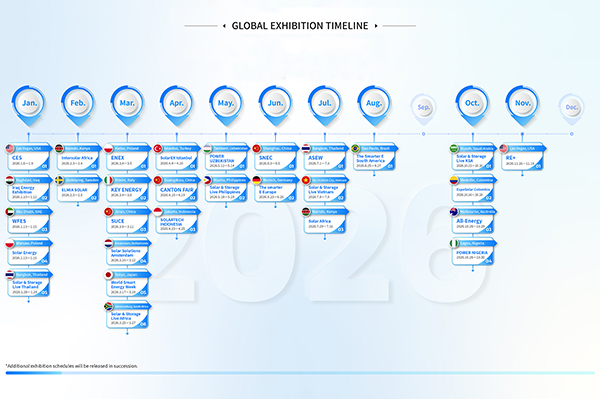 GLOBAL EXHIBITION TIMELINE
*Click to view larger image
-
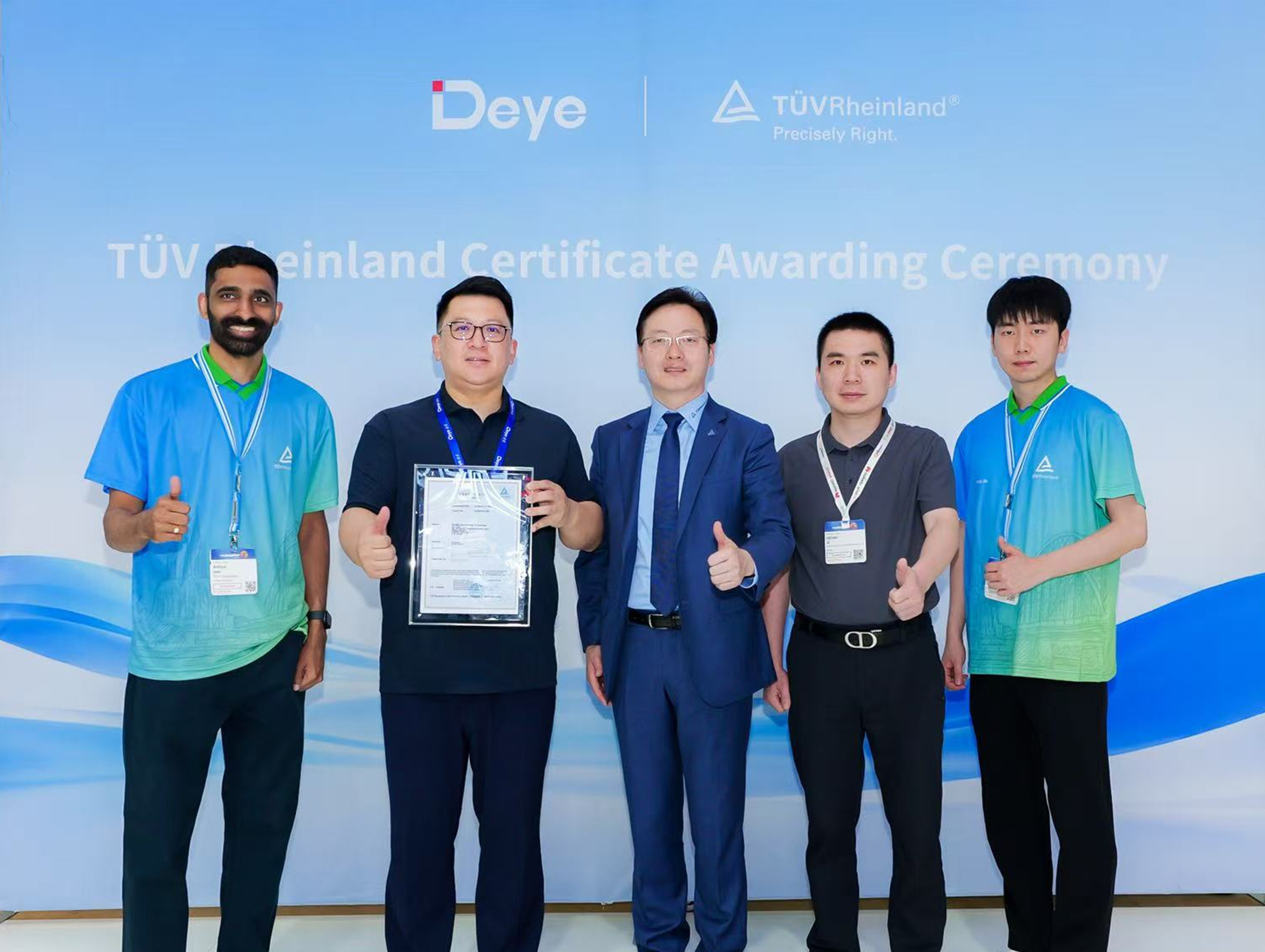 Deye Secures Multiple TÜV Rheinland Certifications at The smarter E Europe
On June 23, the opening day of The smarter E Europe 2026, Deye was officially awarded several presti...
-
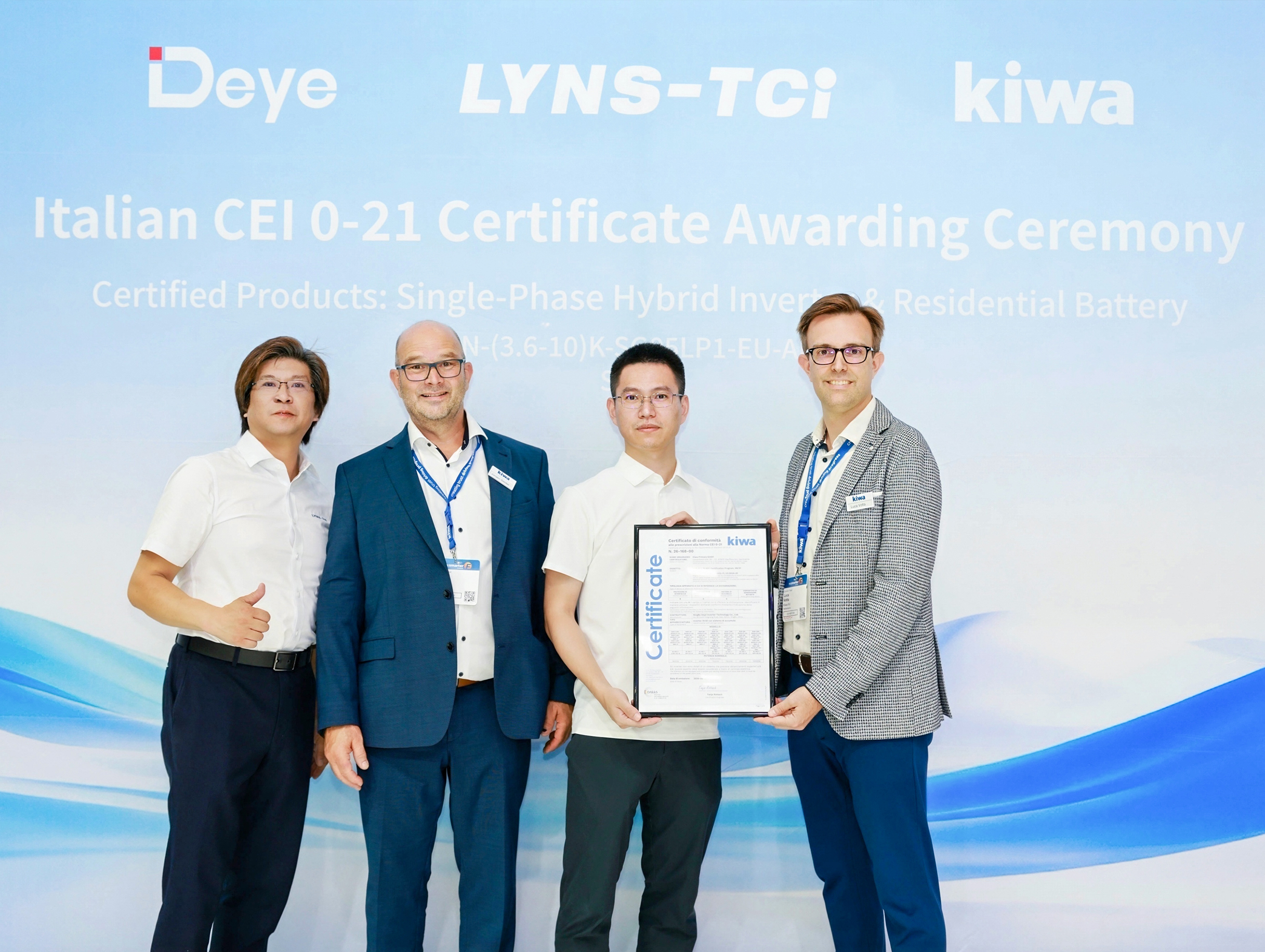 Deye Next-Gen Residential Energy Storage Products Receive Italian CEI 0-21 Certification from Kiwa
At The smarter E Europe 2026, Deye, a leading supplier of inverters and energy storage solutions, of...

Copyright@ 2024.Ningbo Deye Inverter Technology Co.,Ltd. All rights reserved. Solar Inverter Manufacturer
