
 Online Shop
 English
 China - 简体中文
 Global - English
 Brazil - Português
 Netherlands - Dutch
 Italy - Italiano
 Germany - Deutsch
 Spain - Español
 France - Français
 Vietnam - Tiếng Việt
 Poland - Polski
 Australia - English
 Japan - 日本語
Blog
High-Performance Four-MPPT Microinverter for Modern Solar Installations
Solar photovoltaic systems are becoming increasingly diverse. Rooftops now include different roof orientations, partial shading, compact module layouts, high-power PV modules, and challenging environmental conditions. In this context, the choice of inverter architecture has a major influence on energy yield, system safety, monitoring quality, installation flexibility, and long-term operating costs.
The SUN-M130G3-EU-Q0-P1, SUN-M160G3-EU-Q0-P1, and SUN-M200G3-EU-Q0-P1 form a three-model family of single-phase microinverters designed for modern residential and small-scale commercial photovoltaic systems. With output ratings from 1,300 W to 2,000 W, four independent maximum power point tracking channels, a maximum DC input current of 18 A per channel, wireless communication, IP67 protection, rapid shutdown capability, and a 10-year warranty, the series is designed to deliver reliable module-level energy conversion in demanding installation environments.
Unlike a conventional string inverter, which connects multiple PV modules into one or more long DC strings, a microinverter is installed close to the modules and converts direct current into grid-compatible alternating current at the module or small-array level. This architecture can improve design flexibility and reduce the effect of shading, module mismatch, and different roof orientations. The four-MPPT design of this product family further strengthens those benefits by giving each connected PV input its own tracking channel.
Manufactured by Ningbo Deye Inverter Technology Co., Ltd., the product series reflects the company’s broader experience in photovoltaic inverters, energy storage systems, environmental appliances, and energy management technologies. Deye combines research and development, product design, production, sales, and service within an integrated manufacturing organization. Its products are sold in more than 140 countries and regions, while its inverter portfolio covers microinverters, string inverters, hybrid inverters, off-grid equipment, and energy storage solutions.
This article examines the technical design, operating advantages, safety characteristics, monitoring functions, installation value, and manufacturing strengths associated with the SUN-M130/160/200G3-EU-Q0-P1 family.
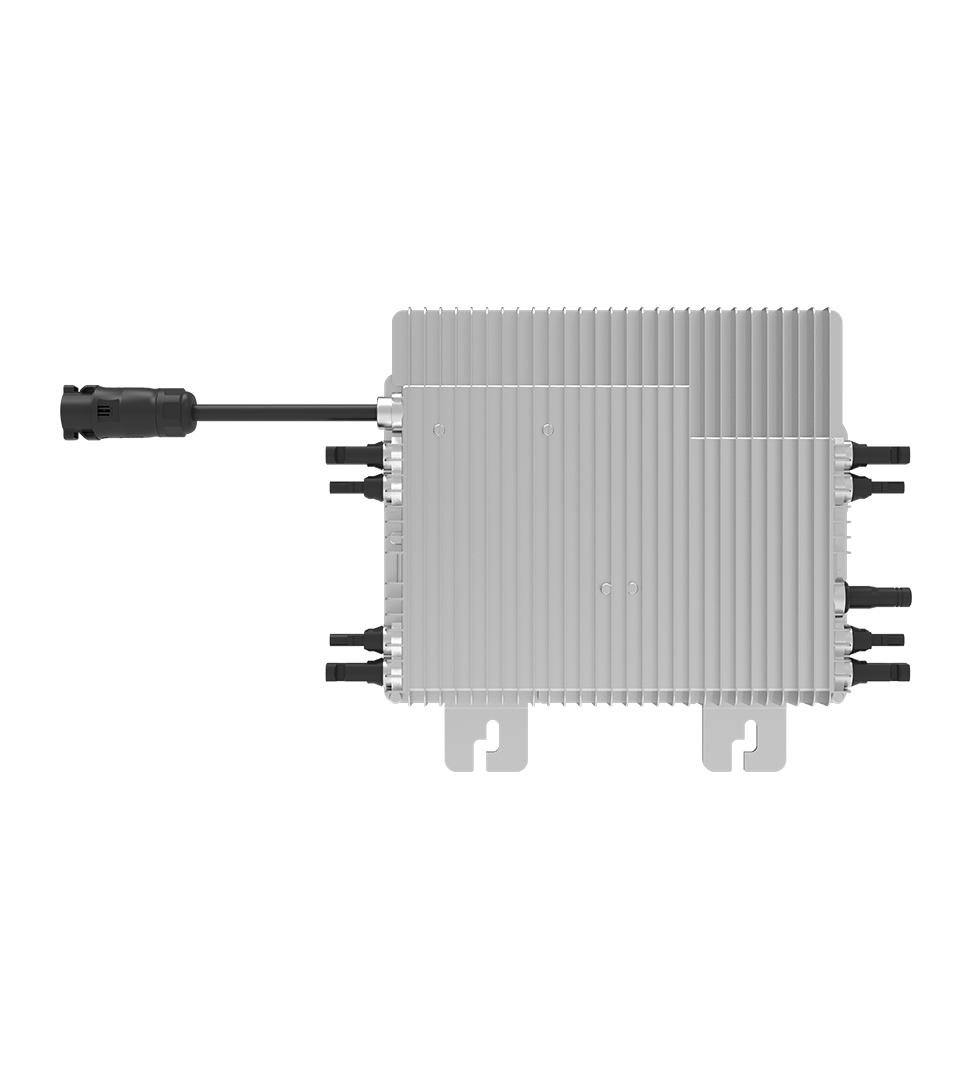
SUN-M130/160/200G3-EU-Q0-P1|1300-2000W | Single Phase | 4 MPPT | Micro Inverter
Product Overview and Model Selection
The product family includes three output classes. The SUN-M130G3-EU-Q0-P1 is rated at 1,300 W, the SUN-M160G3-EU-Q0-P1 is rated at 1,600 W, and the SUN-M200G3-EU-Q0-P1 is rated at 2,000 W. All three models use the same general platform, including four MPP trackers, one string per tracker, single-phase grid connection, wireless communication, free cooling, and an IP67 enclosure.
The primary difference between the models is their output capacity and the recommended PV input range. The 1,300 W model is suitable for four PV modules with a combined recommended STC input range of 210 W to 460 W per module. The 1,600 W model supports modules from 210 W to 560 W, while the 2,000 W model supports modules from 210 W to 700 W. Actual system design should always account for local regulations, module electrical characteristics, ambient temperature, orientation, and the manufacturer’s installation instructions.
| Specification | SUN-M130G3-EU-Q0-P1 | SUN-M160G3-EU-Q0-P1 | SUN-M200G3-EU-Q0-P1 |
|---|---|---|---|
| Rated output power | 1,300 W | 1,600 W | 2,000 W |
| Maximum output apparent power | 1,300 VA | 1,600 VA | 2,000 VA |
| Recommended PV input | 210–460 W per module, four modules | 210–560 W per module, four modules | 210–700 W per module, four modules |
| Maximum DC input voltage | 60 V | 60 V | 60 V |
| MPPT voltage range | 25–55 V | 25–55 V | 25–55 V |
| Full-load DC voltage range | 30–55 V | 30–55 V | 30–55 V |
| Maximum input current | 4 × 18 A | 4 × 18 A | 4 × 18 A |
| Number of MPPT trackers | 4 | 4 | 4 |
| Maximum efficiency | 96.5% | 96.5% | 96.5% |
| Enclosure rating | IP67 | IP67 | IP67 |
| Communication | Wi-Fi | Wi-Fi | Wi-Fi |
| Warranty | 10 years | 10 years | 10 years |
The unified platform simplifies product selection and project planning. Installers can choose the output class that best matches the intended module configuration without changing the basic installation concept. Distributors can also maintain a focused product range while serving different residential roof sizes and module power levels.
Four Independent MPPT Channels
One of the most important features of this microinverter family is its four independent maximum power point trackers. Each of the four DC inputs has its own MPPT channel and accepts one string. This arrangement allows the microinverter to control the operating point of each connected PV module independently.
PV modules rarely operate under identical conditions throughout the day. A tree, chimney, railing, roof structure, dust deposit, or neighboring building may shade only one module or part of an array. Modules may also face different directions or be installed at slightly different tilt angles. In a conventional string architecture, the electrical behavior of modules connected in series can influence one another. A lower-performing module may reduce the output of the entire string, depending on the system design and the effectiveness of bypass and tracking functions.
With four MPPT channels, the product can respond more precisely to the electrical characteristics of four separate inputs. This does not eliminate the physical effects of shade or poor orientation, but it can prevent a problem affecting one input from unnecessarily controlling the operating point of the others. For rooftops with multiple planes or irregular layouts, this is a meaningful design advantage.
The MPPT voltage range is 25 V to 55 V, while the full-load DC voltage range is 30 V to 55 V. The maximum DC input voltage is 60 V. These values make the product suitable for low-voltage module-level conversion, provided the selected PV modules are compatible with the electrical requirements. The maximum input current is 18 A per channel, and the maximum short-circuit current is specified as 27 A per channel.
The high input-current capability is particularly relevant as PV modules continue to increase in size and current output. The product information states that the microinverter can adapt to PV modules up to 600 W. For practical design, installers should verify module operating current, short-circuit current, voltage at the lowest expected temperature, connector compatibility, and applicable local requirements before finalizing a system.
Energy Yield Benefits in Complex Rooftop Conditions
Microinverters are often selected when the roof is electrically or physically complex. A string inverter may be highly effective on a simple, unobstructed roof with a uniform orientation. However, many residential roofs include east-facing, south-facing, west-facing, and occasionally north-facing sections. Some roofs contain dormers, skylights, vents, parapets, or nearby trees that create changing shade patterns.
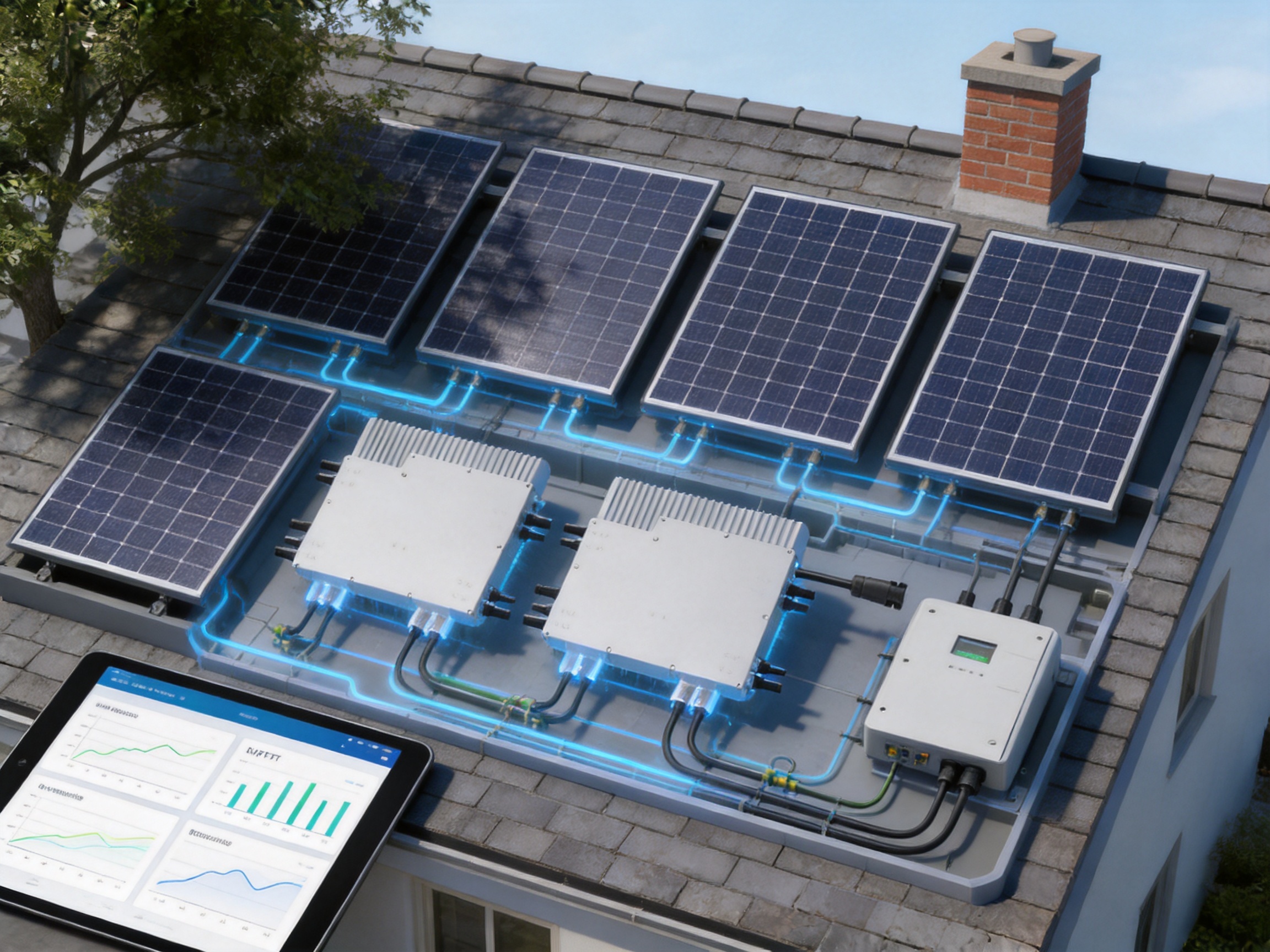
The SUN-M130/160/200G3-EU-Q0-P1 family is designed for this type of distributed generation environment. Because conversion takes place close to the PV modules, designers can build smaller and more flexible AC branches rather than relying on long high-voltage DC strings. Four MPPT channels allow each of the four inputs to be tracked separately, helping the system accommodate differences between modules.
Another advantage is module-level visibility. A conventional string inverter may show the performance of a complete string, but it may not immediately indicate which module is underperforming. A microinverter system can provide more granular operating information, helping identify shading, connector problems, module degradation, wiring issues, or abnormal production at a specific position.
The maximum MPPT efficiency is specified at 99%, while maximum inverter efficiency is specified at 96.5%. These figures indicate that the device is designed to capture and convert a high proportion of available PV energy under suitable operating conditions. Real-world energy yield will also depend on solar irradiation, module temperature, orientation, soiling, cable losses, grid availability, and installation quality.
The three output classes also support a range of module arrangements. The 1,300 W model can be selected for smaller systems or moderate-power modules. The 1,600 W model provides additional output capacity for higher-power modules. The 2,000 W model is intended for larger module power levels and offers the highest AC output in the series. This makes the platform appropriate for new installations as well as phased system expansion.
Safety Through Low-Voltage Module-Level Conversion
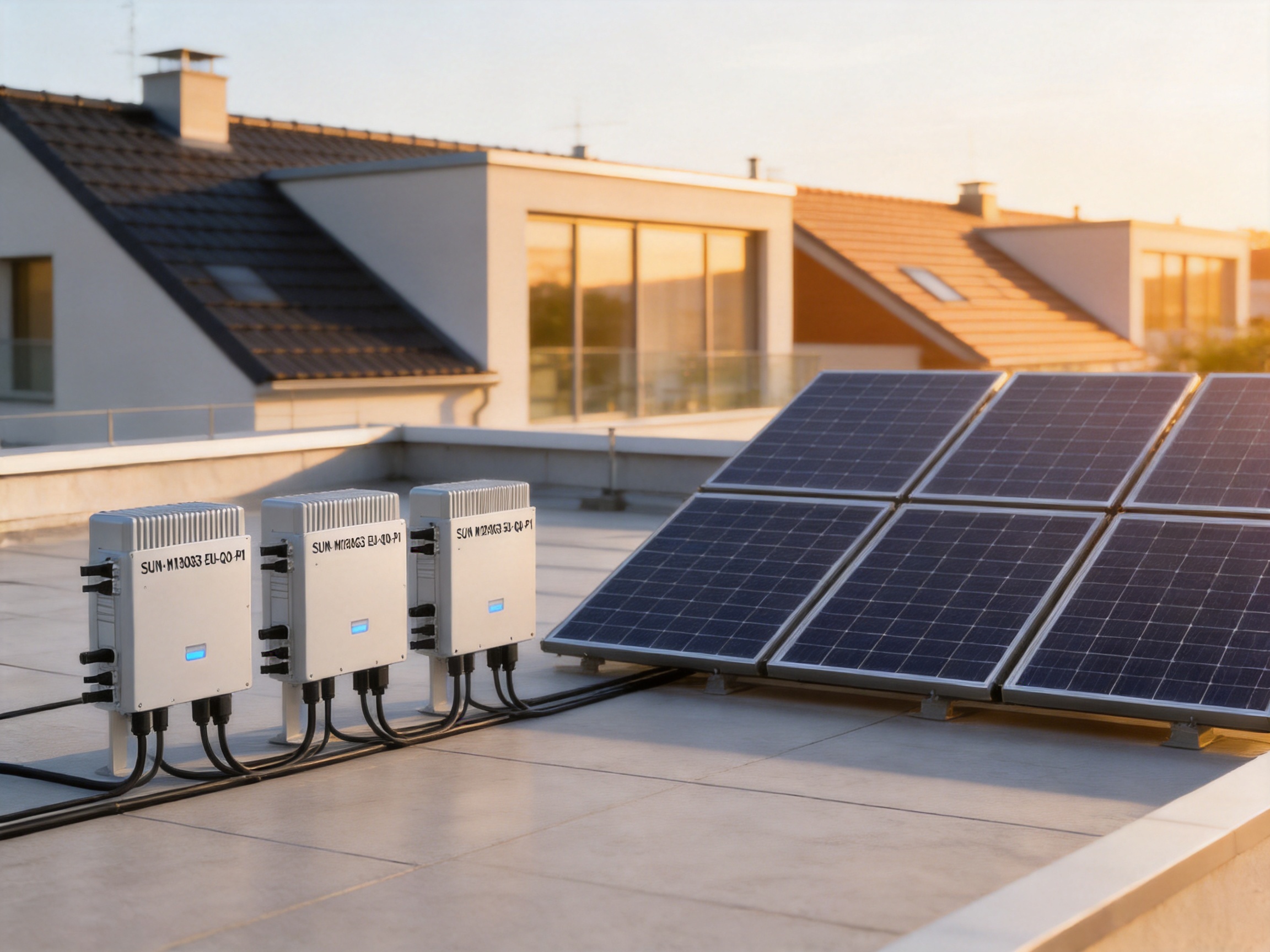
Safety is a central consideration in photovoltaic system design. A conventional string array can operate at several hundred volts or more on the DC side. The SUN-M130/160/200G3-EU-Q0-P1 series uses a maximum DC input voltage of 60 V at the individual microinverter input level. This low-voltage architecture can reduce the hazards associated with long, high-voltage DC strings and simplify certain design and maintenance procedures.
The product also includes a rapid shutdown function. Rapid shutdown is intended to reduce array voltage during emergency situations or when required by applicable electrical codes. The exact implementation, system components, and activation method depend on the complete installation and the requirements of the local authority. Installers must use compatible equipment and follow the product documentation rather than assuming that the microinverter alone satisfies every rapid shutdown requirement.
The enclosure carries an IP67 environmental rating. In general terms, IP67 equipment is designed to provide strong protection against dust ingress and temporary immersion under specified test conditions. This rating supports outdoor rooftop installation, where the equipment may be exposed to rain, humidity, dust, and changing temperatures. Correct cable routing, connector assembly, mounting, and mechanical protection remain essential for maintaining the intended environmental performance.
The product is designed for an ambient temperature range from -40°C to 65°C, with derating above 45°C. Thermal derating is an important protection strategy. When ambient or internal temperatures rise, the microinverter can reduce output to control thermal stress and preserve operating stability. Installers should provide adequate clearance and avoid placing the product where heat is trapped or where ventilation is obstructed.
Free cooling is used instead of a fan-based cooling system. A fanless or free-cooling design can reduce moving parts, acoustic noise, and maintenance requirements. It also avoids the possibility of fan failure becoming a common service issue. Heat dissipation still depends on correct mounting and adequate airflow around the enclosure.
The device is designed according to listed safety and electromagnetic compatibility standards, including IEC/EN 61000-6-1/2/3/4 and IEC/EN 62109-1 and IEC/EN 62109-2. The stated grid connection standards include IEC 61727, IEC 62116, CEI 0-21, EN 50549, NRS 097, RD 140, UNE 217002, OVE-Richtlinie R25, G98, and VDE-AR-N 4105. Since grid certification requirements can vary by country and utility, project teams should confirm the applicable approval before installation.
Single-Phase Grid Connection and Electrical Performance
The microinverter is intended for single-phase grid-connected applications with an L+N+PE connection form. It supports rated output voltage options of 220 V and 230 V within the specified operating ranges. For 220 V systems, the stated range is 184 V to 242 V. For 230 V systems, the stated range is 195.5 V to 253 V.
The rated grid frequency options are 50 Hz and 60 Hz, with operating ranges of 45 Hz to 55 Hz and 55 Hz to 65 Hz respectively. These options enable the product family to serve multiple regional markets, subject to certification, utility rules, and local installation practices.
The rated output current varies by model. The SUN-M130G3-EU-Q0-P1 is specified at 6 A or 5.7 A, the SUN-M160G3-EU-Q0-P1 at 7.3 A or 7 A, and the SUN-M200G3-EU-Q0-P1 at 9.1 A or 8.7 A. The two current values correspond to the supported grid voltage options. Maximum AC output current is specified at the same respective values.
Power factor is specified as greater than 0.99, and current total harmonic distortion is specified as less than 3%. A high power factor indicates that the current is closely aligned with the voltage waveform, while low harmonic distortion helps the inverter operate as a grid-friendly source under suitable conditions. The stated DC component of the grid current is less than 0.5% of rated current according to the supplied technical information.
Branch planning is another practical consideration. The maximum number of units per branch is four for the 1,300 W and 1,600 W models, and three for the 2,000 W model. These limits must be observed when designing AC trunk cables, branch circuits, overcurrent protection, disconnects, and distribution equipment. Local electrical codes and the manufacturer’s installation manual may impose additional requirements.
Wireless Communication and Module-Level Monitoring
The series supports Wi-Fi communication for monitoring and system data exchange. Wireless communication can reduce the need for extensive communication cabling between individual microinverters and a monitoring device, which may be valuable on residential rooftops where installation time and cable management are important.
Module-level monitoring gives installers, system owners, and service teams improved visibility into system operation. Instead of viewing only the combined production of a complete array, users can review the operating status of individual microinverter inputs or module positions, depending on the final monitoring configuration.
This information can assist with several tasks. During commissioning, installers can confirm that each input is producing energy and that the modules are correctly assigned. During operation, owners can compare production across similar modules and identify unusual deviations. During service, technicians can narrow the potential source of a problem before visiting the site.
Monitoring also supports long-term asset management. PV systems are expected to operate for many years, and small production losses can remain unnoticed when there is no detailed performance information. Data from a monitoring platform can help distinguish between weather-related production changes and equipment or module problems.
Wireless communication does not remove the need for good network planning. The quality of the monitoring connection can be influenced by roof construction, distance, interference, equipment placement, and the configuration of the local network. The complete system should be commissioned according to the manufacturer’s procedures, and system owners should retain access credentials and basic maintenance documentation.
Installation Flexibility and Practical Project Value
The physical dimensions of the enclosure are 306 mm by 258 mm by 36.5 mm, excluding connectors and brackets, and the listed weight is 5 kg. Its relatively compact form factor allows the unit to be installed beneath or near a group of PV modules, subject to the prescribed mounting clearances and environmental conditions.
Because one microinverter serves four inputs, the number of power conversion devices can be lower than in a one-microinverter-per-module design while still retaining four independent MPPT channels. This balance can help reduce equipment quantity without giving up the benefits of distributed tracking and monitoring.
The unit can be useful for new construction, rooftop renovation, small commercial buildings, garages, agricultural structures, and residential extensions. It can also support phased installation. A property owner may begin with a smaller group of modules and later add compatible microinverter units as energy demand or budget changes. Any expansion should be checked against branch limits, grid connection capacity, structural conditions, voltage drop, protection requirements, and local approval processes.
AC-side architecture can also simplify certain system layouts. Since conversion occurs at the module level, the roof may not require long runs of high-voltage DC cable between the array and a centralized inverter. This can provide greater freedom in placing the AC distribution equipment and may reduce some DC design complications. Nevertheless, all AC wiring, grounding, disconnecting, and overcurrent protection must be designed and installed by qualified personnel.
The product’s operating temperature range and IP67 rating provide a strong foundation for outdoor service, but environmental protection is not automatic. Connectors must be fully engaged, unused openings must be properly sealed, cables must be supported, and the mounting surface must be suitable. Water should not be allowed to collect around cable entry points or connector interfaces.
Comparison with Conventional String Inverter Approaches
The most appropriate inverter architecture depends on the project. String inverters can be highly competitive for large, uniform arrays with minimal shade and a straightforward roof layout. They often centralize conversion and can be efficient in installations with long, consistent strings. However, a distributed microinverter approach offers distinct benefits where module conditions vary.
First, the four-MPPT architecture reduces the electrical impact of differences among connected modules. Each input can be tracked separately, which is especially useful where roof planes have different orientations or where partial shading changes throughout the day.
Second, module-level monitoring can make troubleshooting more precise. A string inverter may require additional module-level electronics to provide comparable visibility, while a microinverter platform is inherently distributed around the PV array.
Third, the low-voltage input architecture can reduce the presence of long high-voltage DC strings. This may simplify certain safety and shutdown considerations, although the complete system still contains live electrical circuits and must be handled according to applicable regulations.
Fourth, microinverters can offer greater design freedom for small or irregular systems. Modules do not always need to be arranged into long, uniform strings with identical orientation and electrical conditions. This flexibility can be valuable on residential roofs where architectural constraints dominate the design.
The SUN-M130/160/200G3-EU-Q0-P1 family strengthens the typical microinverter proposition through its combination of four MPPT inputs, high current handling, three output ratings, rapid shutdown, IP67 protection, Wi-Fi communication, and a 10-year warranty. These features address energy production, compatibility, safety, commissioning, and long-term ownership in one platform.
Product Advantages in Competitive Selection
When comparing microinverters, purchasers should consider more than nominal output power. The most important criteria include input-current capability, number of MPPT channels, operating voltage range, branch capacity, environmental protection, communication, grid certifications, thermal behavior, warranty, and the manufacturer’s ability to provide long-term service.
The product family has several characteristics that can distinguish it in a competitive evaluation.
Four trackers in a compact platform
Four MPP trackers allow four independent PV inputs to operate at their own maximum power points. This provides a strong balance between module-level optimization and equipment consolidation. It is particularly suitable for rooftops with multiple orientations or uneven shading.
Compatibility with higher-current modules
The maximum input current of 18 A per channel supports modern PV modules with higher operating current than many older module generations. The product information specifically identifies adaptation to PV modules up to 600 W. Designers should still check the exact module current and voltage values, but the current rating provides useful headroom for contemporary module technology.
Multiple output ratings
The 1,300 W, 1,600 W, and 2,000 W versions allow installers to match inverter capacity with module power and project size. A common platform across three ratings can simplify training, procurement, spare-parts planning, and installation procedures.
Outdoor-ready construction
IP67 protection, a -40°C to 65°C ambient temperature range, and free cooling support outdoor rooftop deployment. Derating above 45°C provides a thermal management response for hot conditions rather than requiring the equipment to operate at full output regardless of temperature.
Integrated safety functions
Rapid shutdown, compliance with listed safety standards, low-voltage DC input operation, and controlled grid interaction contribute to a safer system design. These functions must be considered as part of the complete PV installation, not in isolation.
Long-term support proposition
A 10-year warranty provides a defined period of product coverage and can improve confidence for homeowners, installers, and commercial asset owners. Warranty value is strongest when supported by clear commissioning records, qualified installation, accessible technical support, and a stable manufacturer with broad international experience.
Manufacturing and Engineering Strengths
Product performance depends not only on the circuit design but also on the quality and consistency of manufacturing. Microinverters operate outdoors, convert power continuously, communicate with monitoring systems, and interact with the public grid. Manufacturing discipline is therefore essential.
Ningbo Deye Inverter Technology Co., Ltd. operates as a comprehensive technology manufacturing enterprise integrating research and development, design, production, sales, and service. This integrated structure can improve coordination between engineering teams, production departments, quality management, and customer support. Feedback from field applications can be incorporated into product development, while manufacturing teams can provide early input on assembly feasibility, testing, and process control.
The company’s experience covers a broad range of power electronics. Its core inverter products include string inverters from 1 kW to 136 kW, energy storage inverters from 3 kW to 80 kW, and microinverters from 300 W to 2.2 kW. This breadth gives the manufacturer exposure to different power levels, grid requirements, communication methods, thermal challenges, and application environments.
Manufacturing strength is also supported by product-family development. The three models in this series share a common engineering concept while offering different output capacities. Platform-based development can help standardize components, assembly procedures, inspection methods, software practices, and service knowledge. It can also support more consistent quality across different capacity classes.
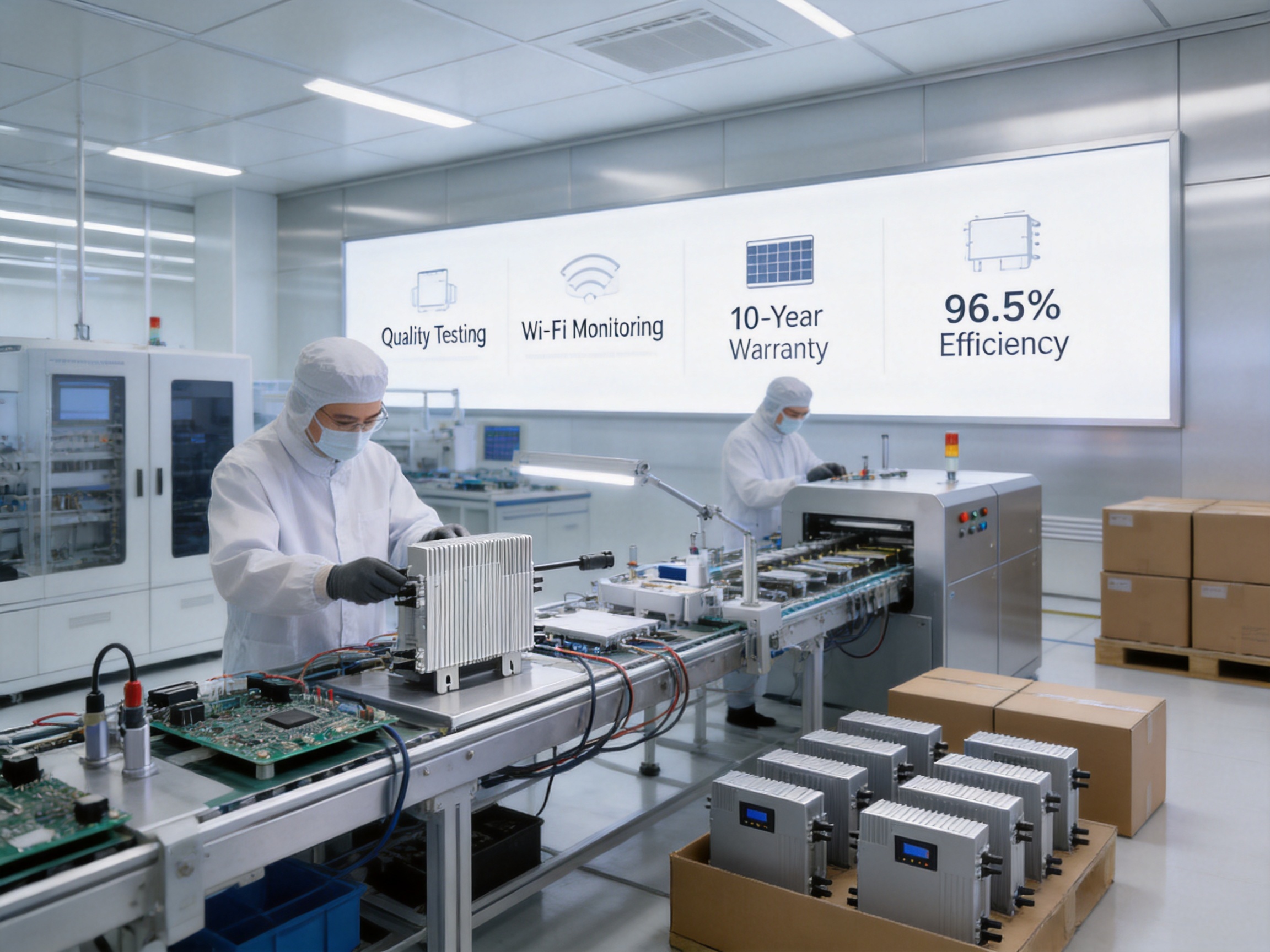
A robust manufacturing process for microinverters generally includes controlled printed circuit board assembly, component traceability, mechanical assembly, connector inspection, firmware loading, electrical safety checks, functional testing, communication testing, and final product inspection. While specific factory procedures are not detailed in the supplied product materials, these are the types of process controls expected for grid-connected power conversion equipment.
Electrical testing is particularly important. Each finished microinverter must be evaluated for correct DC input behavior, AC output performance, protection functions, grid synchronization, communication response, and fault handling. Testing helps identify assembly defects before shipment and contributes to stable field performance.
Thermal and environmental design also require manufacturing consistency. The enclosure, seals, connectors, thermal interfaces, and internal components must be assembled accurately to achieve the intended IP67 protection and heat dissipation performance. Small variations in sealing or mechanical fit can affect long-term outdoor reliability, which is why process control is important for every production batch.
Deye’s international market presence provides additional manufacturing and compliance experience. The product family lists grid connection standards for Europe, South Africa, Australia, and other markets. Supporting multiple regulatory environments requires attention to firmware behavior, protection thresholds, electromagnetic compatibility, documentation, labeling, and certification management.
The company was founded in 2000 and was listed on the Shanghai Stock Exchange in April 2021. Its long operating history and public-company status provide an organizational foundation for continued investment in research, production capability, quality systems, and global service infrastructure.
Quality, Reliability, and Lifecycle Considerations
A microinverter is expected to remain outdoors for many years while experiencing daily thermal cycling, humidity, solar radiation, dust, vibration, and electrical transients. Reliability therefore depends on the interaction of materials, circuit design, firmware, enclosure construction, manufacturing quality, installation practice, and maintenance.
The IP67 enclosure rating is a key part of the environmental design. However, it should be understood as a tested protection classification rather than a guarantee against every environmental condition. Correct installation is necessary to preserve the rating. Connectors should be selected and assembled correctly, cable loops should prevent water from running directly into connection points, and physical impact should be avoided.
The wide temperature specification is also valuable for geographically diverse markets. The stated range of -40°C to 65°C covers very cold and very hot ambient conditions. Because output derating occurs above 45°C, system designers should consider the local climate, roof surface temperature, mounting position, and expected operating profile when estimating annual energy production.
Free cooling can support reliability by eliminating fan bearings and fan motors. Fewer moving parts can mean fewer mechanical failure modes and lower acoustic output. The trade-off is that the product must be mounted where natural heat dissipation is possible. Installers should not cover the enclosure with insulation or place it in a confined space without following the required clearances.
The 10-year warranty provides a defined lifecycle commitment. For commercial purchasers, warranty terms should be reviewed together with service procedures, replacement logistics, exclusions, registration requirements, and the availability of authorized support in the target market.
Recommended Design and Installation Workflow
A successful installation begins with a complete site assessment. The designer should identify roof planes, shading sources, module dimensions, tilt and azimuth, cable routes, structural constraints, local grid voltage, frequency, utility requirements, and the intended point of interconnection.
The next step is module compatibility. Each selected PV module should be checked against the microinverter’s maximum DC voltage, MPPT voltage range, full-load voltage range, operating current, and short-circuit current. The module’s voltage at the lowest expected temperature deserves particular attention because cold conditions can increase open-circuit voltage.
The correct product model should then be selected. The 1,300 W, 1,600 W, and 2,000 W ratings should be matched with the planned module power and the expected operating conditions. The designer should avoid treating the recommended input range as a substitute for a full electrical compatibility review.
AC branch capacity must be planned carefully. The stated maximum number of units per branch is four for the 1,300 W and 1,600 W models and three for the 2,000 W model. Branch cable size, voltage drop, overcurrent protection, disconnects, grounding, and distribution equipment must be sized in accordance with the applicable code and installation manual.
Mechanical mounting should provide secure support and appropriate airflow. The microinverter should not be installed where it may be regularly exposed to standing water, excessive heat accumulation, corrosive chemicals, or mechanical damage. Cable connectors should be protected from sharp edges and excessive tension.
After installation, commissioning should include visual inspection, polarity verification, connector inspection, grounding checks, AC voltage confirmation, communication setup, and production verification. Each connected module or input should be checked through the monitoring platform where possible.
Owners should receive documentation showing the installed model numbers, serial numbers, module configuration, branch layout, protection devices, commissioning date, and warranty information. This documentation can significantly reduce future troubleshooting time.
Applications for Residential and Small Commercial Systems
Residential rooftops are a natural application for this product family. Homes often have limited roof area, several roof orientations, partial shade from trees, and changing electricity consumption patterns. The four-input structure enables a practical design for a group of modules while maintaining independent tracking.
The product can also serve small commercial premises such as offices, retail stores, workshops, schools, and agricultural buildings. These sites may have a larger roof than a typical home but still benefit from distributed conversion when sections of the roof have different orientations or shading conditions.
Small commercial users may value module-level monitoring because it supports preventive maintenance. A business can identify a performance issue without waiting for a large reduction in total system output. This can help maintenance teams prioritize inspections and reduce unnecessary site visits.
Garages, carports, and extensions may also benefit from the product’s flexible architecture. These structures can have unusual roof geometry or may be built in stages. A modular AC-based approach can make the system easier to adapt as the site develops.
For systems using battery storage, the microinverter may be incorporated into a broader energy solution, but compatibility must be assessed at the system level. The supplied product information identifies the unit as a grid-connected microinverter. It should not be assumed to provide backup power or off-grid operation unless the complete system includes appropriately rated equipment and has been designed for that purpose.
Operating Data and Maintenance
The product has a stated nighttime power consumption of 50 mW. This low standby consumption helps limit energy use when PV generation is unavailable. During daylight, operating efficiency depends on input voltage, current, module temperature, irradiance, output loading, and grid conditions.
Routine maintenance should include visual inspection of the enclosure, mounting hardware, cables, connectors, and surrounding area. The system owner should monitor production data and investigate persistent deviations between similar modules or inputs. Dirt, shading growth, animal damage, corrosion, and roof work can all influence system performance.
Cleaning procedures should follow the recommendations for the PV modules and electrical equipment. High-pressure water, harsh chemicals, or direct spraying into connectors should be avoided unless explicitly permitted by the manufacturer. Electrical maintenance must be conducted by qualified personnel with appropriate isolation procedures.
Firmware, communication, and monitoring settings should be managed according to the approved process. Unauthorized changes to grid protection parameters can create safety and compliance risks. If a system is relocated, expanded, or connected to a different grid configuration, it should be reassessed and recommissioned.
Service teams can benefit from the product’s module-level architecture because fault diagnosis can begin with the specific input or unit showing abnormal behavior. This can reduce the time required to isolate a problem compared with troubleshooting an entire string without detailed monitoring information.
Why Manufacturer Capability Matters
Choosing a microinverter is also a decision about the supplier behind the equipment. A technically capable manufacturer can provide more than hardware. It can support certification, firmware development, application engineering, production consistency, spare parts, warranty administration, and field service.
Deye’s business covers PV inverters, energy storage systems, and environmental products such as dehumidifiers and HVAC equipment. This diversified technology base demonstrates experience with power electronics, thermal management, control systems, embedded software, and mass production. The company also develops energy IoT technologies centered on the Deye Cloud App, as well as LoRa-based wireless energy management solutions.
Its broad product portfolio enables the company to address residential, commercial, industrial, and utility applications. This is relevant for installers and distributors that want to work with one technology provider across different project types. A supplier able to provide microinverters, string inverters, hybrid inverters, off-grid products, EV charging equipment, and energy storage can help simplify portfolio management.
Global distribution experience is another strength. Products sold across more than 140 countries and regions must accommodate different grid codes, climates, languages, installer expectations, and service conditions. Such experience can contribute to better documentation and more mature international support procedures.
The company’s integrated structure also supports faster coordination. Research teams can develop new functions, manufacturing teams can prepare production processes, sales teams can communicate market needs, and service teams can report field experience. When these activities are connected, product improvements can be managed more systematically.
Technical Summary
| Category | Key information |
|---|---|
| Product type | Single-phase grid-connected microinverter |
| Models | SUN-M130G3-EU-Q0-P1, SUN-M160G3-EU-Q0-P1, SUN-M200G3-EU-Q0-P1 |
| Output range | 1,300 W to 2,000 W |
| Input architecture | Four independent DC inputs |
| MPPT channels | Four |
| Strings per MPPT | One |
| Maximum DC input voltage | 60 V |
| MPPT voltage range | 25 V to 55 V |
| Maximum input current | 4 × 18 A |
| Maximum efficiency | 96.5% |
| MPPT efficiency | 99% |
| Communication | Wi-Fi |
| Safety function | Rapid shutdown |
| Environmental protection | IP67 |
| Cooling | Free cooling |
| Ambient temperature | -40°C to 65°C, with derating above 45°C |
| Dimensions | 306 × 258 × 36.5 mm, excluding connectors and brackets |
| Weight | 5 kg |
| Warranty | 10 years |
Questions and Answers
What type of product is the SUN-M130/160/200G3-EU-Q0-P1 family?
It is a single-phase grid-connected microinverter family. The range includes three models with rated output powers of 1,300 W, 1,600 W, and 2,000 W.
How many PV modules can one unit support?
The unit has four DC inputs, four MPPT trackers, and one string per MPPT tracker. The recommended configuration is four PV modules, subject to the voltage, current, power, connector, and installation requirements of the selected model.
What is the benefit of four MPPT trackers?
Four independent trackers allow the inverter to optimize four inputs separately. This can be valuable when modules experience different shading, orientations, tilts, temperatures, or electrical characteristics.
Can the microinverter work with high-power PV modules?
The product information states that the microinverter can adapt to PV modules up to 600 W and provides a maximum input current of 18 A per channel. The exact module must still be checked against all voltage and current limits before installation.
What is the maximum DC voltage?
The maximum input DC voltage is 60 V. The MPPT voltage range is 25 V to 55 V, and the full-load DC voltage range is 30 V to 55 V.
Does the product include rapid shutdown?
Yes. Rapid shutdown is listed as one of the product features. The complete installation must use compatible equipment and comply with the applicable local electrical and fire-safety requirements.
Is the microinverter suitable for outdoor installation?
It is designed for outdoor use with an IP67 enclosure rating and an ambient temperature range of -40°C to 65°C. Proper mounting, connector assembly, cable routing, and clearance are still necessary.
Does it use a cooling fan?
No. The product uses free cooling. This reduces moving parts and operating noise, but the enclosure must be installed where adequate natural heat dissipation is available.
How is system performance monitored?
The product supports Wi-Fi communication and module-level monitoring. The final monitoring arrangement depends on the system configuration, communication environment, and commissioning procedure.
How many units can be connected in one branch?
The stated maximum is four units per branch for the SUN-M130G3-EU-Q0-P1 and SUN-M160G3-EU-Q0-P1, and three units per branch for the SUN-M200G3-EU-Q0-P1. Local codes and the installation manual must also be followed.
What is the warranty period?
The listed warranty period is 10 years. Purchasers should review the applicable warranty terms, registration conditions, service procedures, and regional support arrangements.
Can the microinverter provide backup power during a grid outage?
The supplied information describes the product as a grid-connected microinverter. Backup or off-grid operation should not be assumed. A qualified designer must evaluate any proposed storage or backup configuration using compatible equipment.
Who manufactures the product?
The product is manufactured by Ningbo Deye Inverter Technology Co., Ltd., a technology manufacturer with product lines covering microinverters, string inverters, hybrid inverters, off-grid inverters, and energy storage systems.
Conclusion
The SUN-M130G3-EU-Q0-P1, SUN-M160G3-EU-Q0-P1, and SUN-M200G3-EU-Q0-P1 microinverters provide a flexible platform for modern single-phase photovoltaic systems. Their most important technical advantage is the combination of four independent MPPT channels with high-current DC inputs. This architecture supports module-level optimization and can accommodate rooftops with different orientations, partial shading, and high-power PV modules.
The product family also addresses the practical requirements of outdoor solar equipment. IP67 protection, a wide ambient temperature range, free cooling, rapid shutdown, Wi-Fi communication, module-level monitoring, and a 10-year warranty contribute to a complete ownership proposition. Output ratings from 1,300 W to 2,000 W give installers options for different module configurations and system sizes.
Its competitive value is reinforced by the manufacturer’s integrated capabilities. Deye combines research and development, product design, production, sales, and service, while maintaining a broad portfolio of PV and energy storage technologies. Experience across multiple power ranges and international grid standards supports the development of equipment intended for diverse global applications.
For the best results, the product should be selected as part of a complete engineering process. Module electrical compatibility, branch limits, grid requirements, thermal conditions, mounting, communication, rapid shutdown, and commissioning must all be reviewed by qualified professionals. When correctly designed and installed, this four-MPPT microinverter family can provide a practical foundation for safe, observable, and adaptable solar generation.
References
Deye. SUN-M130G3-EU-Q0-P1, SUN-M160G3-EU-Q0-P1, and SUN-M200G3-EU-Q0-P1 Product Technical Information.
Ningbo Deye Inverter Technology Co., Ltd. Corporate and Product Portfolio Information.
IEC 62109-1. Safety of Power Converters for Use in Photovoltaic Power Systems: General Requirements.
IEC 62109-2. Safety of Power Converters for Use in Photovoltaic Power Systems: Particular Requirements for Inverters.
IEC 61727. Photovoltaic Systems: Characteristics of the Utility Interface.
IEC 62116. Utility-Interconnected Photovoltaic Inverters: Test Procedure of Islanding Prevention Measures.
EN 50549. Requirements for the Connection of Generators in Parallel with Public Distribution Networks.
IEC 61000 Series. Electromagnetic Compatibility Requirements for Electrical and Electronic Equipment.
Product: SUN-M130/160/200G3-EU-Q0-P1|1300-2000W | Single Phase | 4 MPPT | Micro Inverter

PREV:Wireless Energy Metering for Smarter Solar and Energy Storage Systems
NEXT:Compact High-Performance Microinverters for Flexible Residential Solar Systems
Share
Product recommendations
news recommendations
-
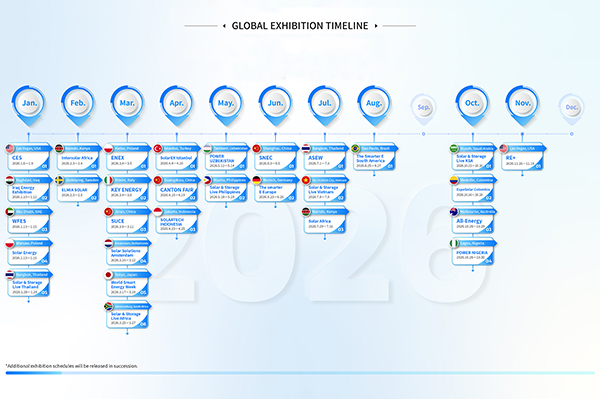 GLOBAL EXHIBITION TIMELINE
*Click to view larger image
-
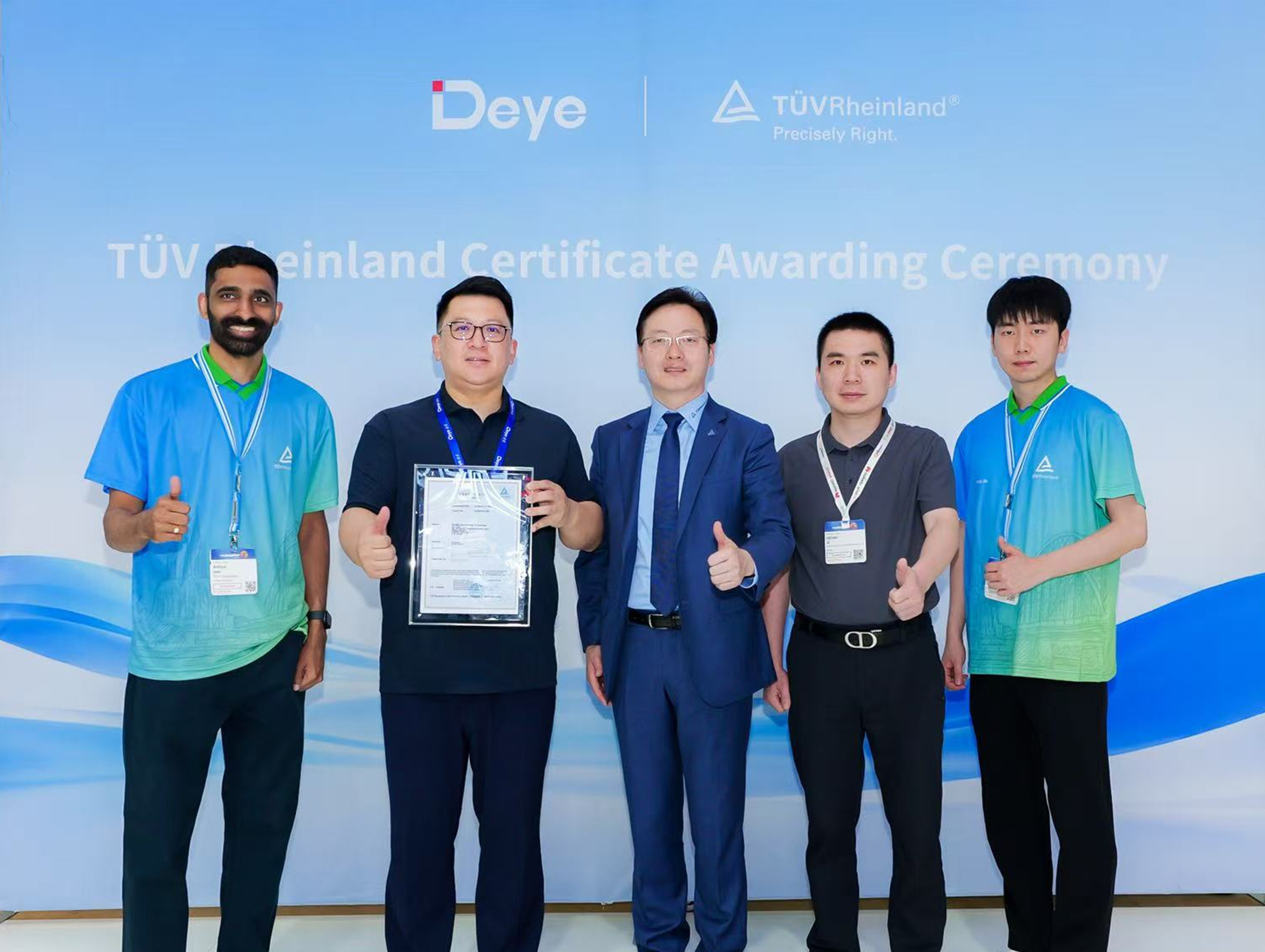 Deye Secures Multiple TÜV Rheinland Certifications at The smarter E Europe
On June 23, the opening day of The smarter E Europe 2026, Deye was officially awarded several presti...
-
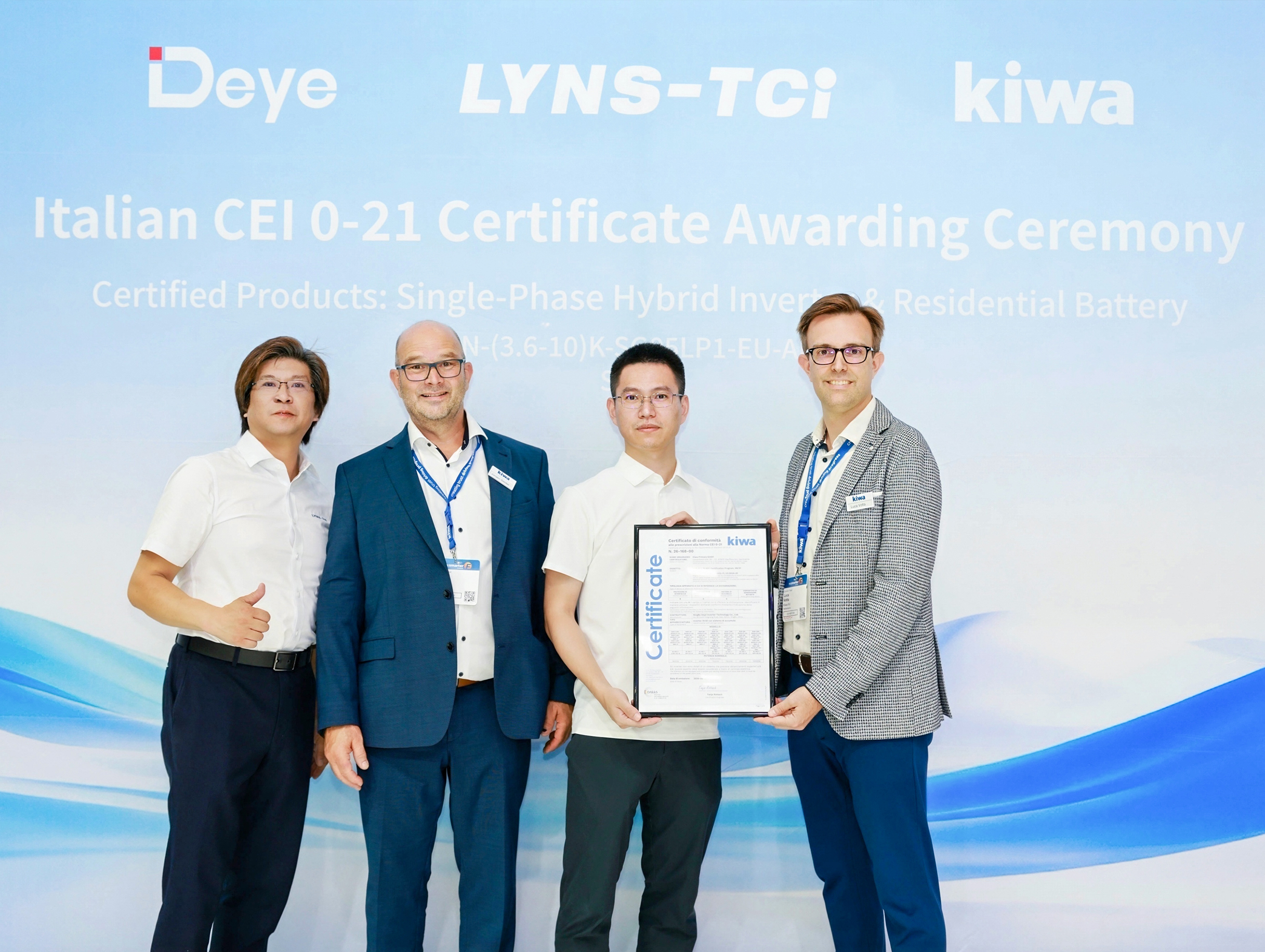 Deye Next-Gen Residential Energy Storage Products Receive Italian CEI 0-21 Certification from Kiwa
At The smarter E Europe 2026, Deye, a leading supplier of inverters and energy storage solutions, of...

Copyright@ 2024.Ningbo Deye Inverter Technology Co.,Ltd. All rights reserved. Solar Inverter Manufacturer
