
 Online Shop
 English
 China - 简体中文
 Global - English
 Brazil - Português
 Netherlands - Dutch
 Italy - Italiano
 Germany - Deutsch
 Spain - Español
 France - Français
 Vietnam - Tiếng Việt
 Poland - Polski
 Australia - English
 Japan - 日本語
Blog

High-Voltage Three-Phase Hybrid Inverter for Scalable Solar Energy Storage
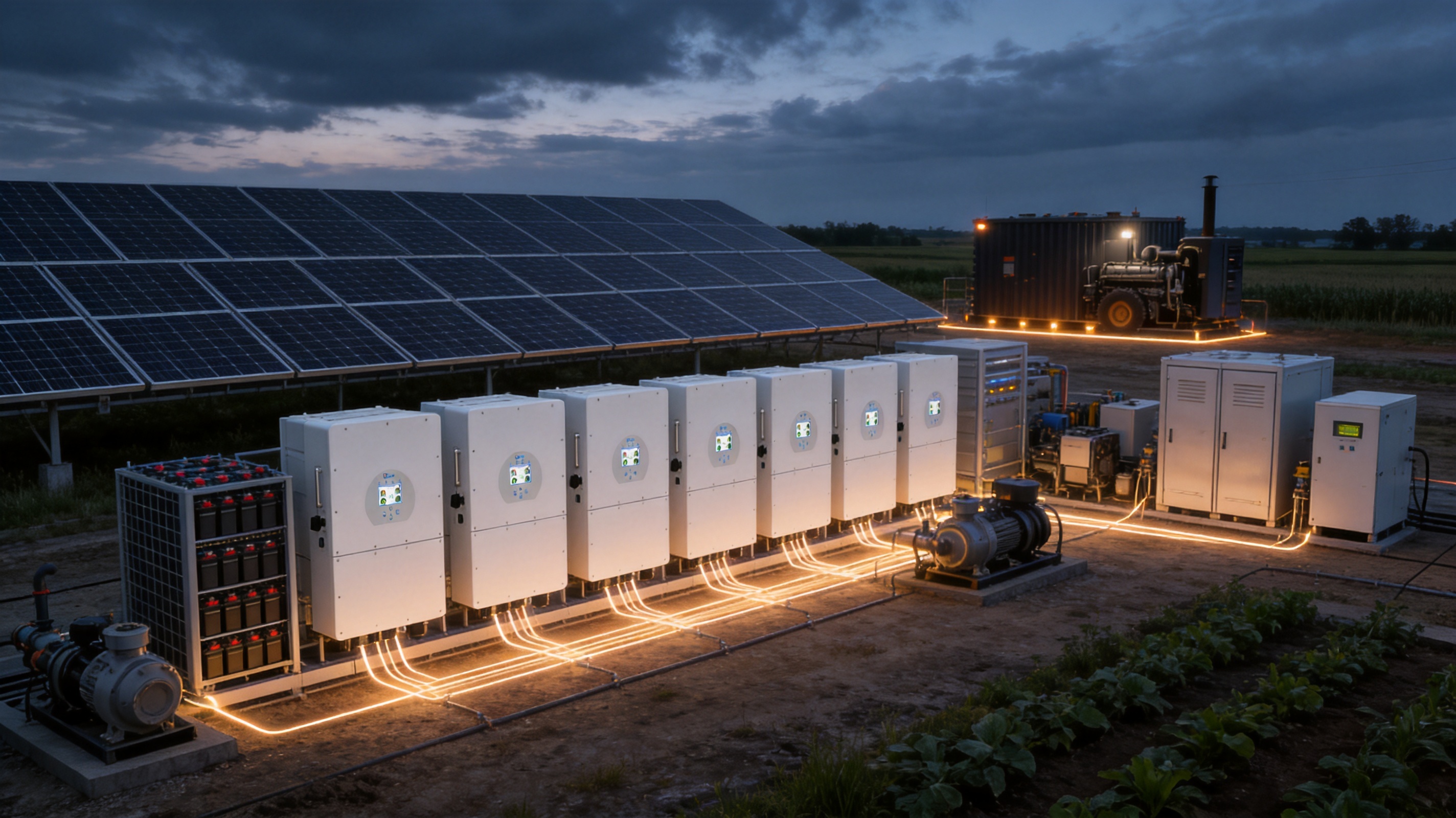
The transition from conventional grid-connected solar generation to intelligent, flexible energy management requires more than a photovoltaic inverter. Modern homes, farms, commercial buildings, and light industrial facilities increasingly need equipment that can combine solar generation, battery storage, grid power, backup loads, and generator input in one coordinated system. The SUN-(5-25)K-SG01HP3-EU-AM2 is designed for this purpose as a three-phase high-voltage hybrid inverter covering power ratings from 5 kW to 25 kW.
This inverter family combines two maximum power point trackers, high-voltage lithium-ion battery compatibility, advanced grid-interactive functions, off-grid backup capability, and support for parallel operation. Its design allows an installation to begin as a solar-plus-storage system and expand as electricity demand grows. It can also be used to retrofit an existing photovoltaic installation through AC coupling, reducing the need to replace functioning solar equipment.
The product is manufactured by Ningbo Deye Inverter Technology Co., Ltd., a technology manufacturer with experience in photovoltaic inverters, energy storage systems, environmental appliances, and digital energy management. The company operates across research and development, product design, manufacturing, sales, and service, supporting a broad international customer base.
With a rated output range of 5 kW to 25 kW, the product series is suitable for applications that require three-phase energy conversion, battery charging and discharging, backup power, and coordinated energy scheduling. It is particularly suited to users who need a system that can manage variable solar production while maintaining stable power for important loads.
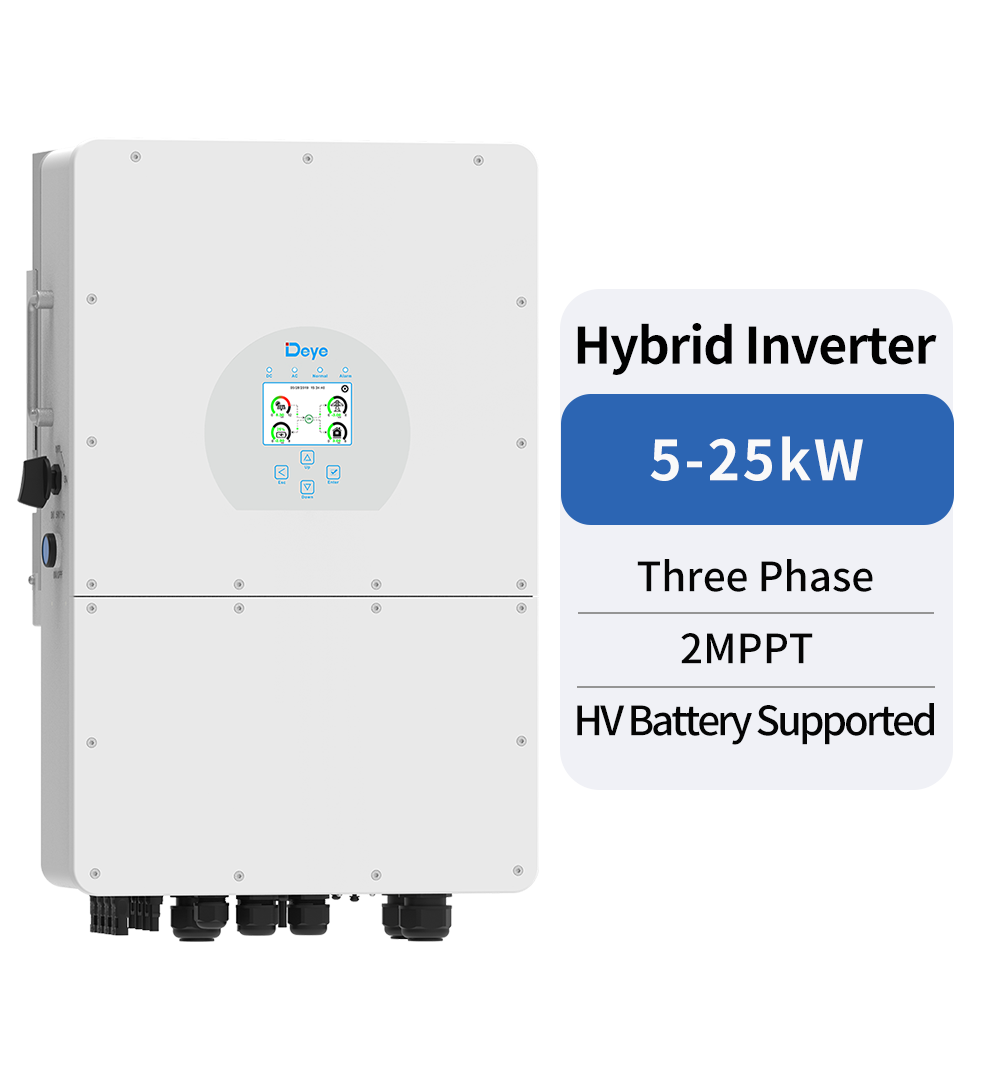
SUN-5/6/8/10/12/15/20/25K-SG01HP3-EU-AM2
Product Positioning and Main Application Value
The SUN-(5-25)K-SG01HP3-EU-AM2 belongs to the three-phase high-voltage hybrid inverter category. Unlike a basic grid-tie inverter, it does not only convert direct-current electricity from photovoltaic modules into alternating-current electricity for the grid. It also controls the charging and discharging of a high-voltage battery, supplies loads during grid interruptions, accepts AC energy from the grid or a generator, and coordinates multiple operating modes.
The product family includes eight nominal power classes: 5 kW, 6 kW, 8 kW, 10 kW, 12 kW, 15 kW, 20 kW, and 25 kW. This range enables system designers to select an inverter that is close to the required load profile instead of oversizing a single model for every project.
Typical applications include:
Residential buildings with three-phase electrical service and high evening consumption.
Large homes that require battery backup for refrigeration, heating, pumps, communications equipment, and other essential loads.
Small farms and agricultural facilities with irrigation systems, workshops, storage buildings, and variable daytime demand.
Retail stores, offices, restaurants, and professional buildings seeking to reduce peak electricity purchases.
Small manufacturing sites and commercial facilities requiring backup capability and improved solar self-consumption.
Existing photovoltaic systems that need battery storage without replacing the original PV inverter.
Remote or weak-grid installations where a diesel generator may be used as a supplemental energy source.
The broad power range and parallel architecture also make the series suitable for staged deployment. A customer may install one inverter and a moderate battery bank initially, then add more battery capacity or parallel inverters when the load increases.
Core Functional Advantages
High-voltage battery architecture
The inverter supports a lithium-ion battery voltage range of 160 V to 700 V. High-voltage battery systems can reduce current for a given power level compared with low-voltage battery systems. Lower current can help reduce cable losses, simplify conductor sizing, and support more efficient power transfer between the battery and inverter.
High-voltage operation is especially valuable at the upper end of the product range. A 20 kW or 25 kW inverter would require substantial current if paired with a low-voltage battery bank. By using a higher DC voltage, the system can transfer significant energy with a more manageable current level and a compact connection structure.
The inverter supports battery charging and discharging currents of up to 50 A, depending on the selected model. The supplied product data identifies 30 A, 37 A, and 50 A current classes across the range. Correct battery selection remains essential because the battery management system, operating voltage, permitted current, and communication protocol must all be compatible with the inverter.
Support for unbalanced three-phase loads
A major feature of this product family is 100% unbalanced output capability. In a three-phase installation, loads are rarely distributed perfectly equally among all phases. One phase may supply a single-phase water pump, another may supply lighting and appliances, while the third may feed office equipment or workshop tools.
Conventional systems may experience limitations when phase loads are uneven. The ability to provide fully unbalanced output allows the hybrid inverter to respond more effectively to real-world load conditions. This is important in buildings where phase balancing is difficult or where the load changes throughout the day.
For system designers, this feature can reduce the need for extensive load redistribution during installation. It can also improve the practical value of stored energy because battery power can be directed toward the phase where it is required rather than being restricted by an overly rigid balance requirement.
AC coupling for retrofit projects
The inverter can be AC coupled to an existing solar system. This capability is valuable when an installation already has a functioning PV inverter but needs energy storage, backup power, or improved energy management.
Replacing an existing inverter can add cost, downtime, wiring changes, and disposal requirements. AC coupling offers an alternative approach: the existing inverter continues to convert solar energy, while the new hybrid inverter manages the battery and coordinates power flow through the AC system.
Retrofit projects can be technically complex, so the installer must evaluate the existing inverter, grid protection requirements, generator configuration, export limitations, and backup-load arrangement. Nevertheless, AC coupling gives the product a broader market position than a hybrid inverter designed only for new-build installations.
Parallel operation for expansion
Up to ten units can be connected in parallel for both on-grid and off-grid operation. This is one of the most important scalability advantages of the series. A single inverter can serve a moderate installation, while multiple units can provide higher total output or additional redundancy for a larger project.
Parallel operation can support phased investment. The initial system may be sized for current loads, and additional inverters can be added as the property expands, electric vehicle charging is introduced, production equipment is installed, or more battery storage becomes necessary.
Parallel systems require careful engineering. The installation must follow the manufacturer’s wiring, communication, synchronization, protection, and commissioning procedures. Cable lengths, phase sequence, battery communication, current sharing, circuit protection, and grounding must all be considered. When correctly designed, a parallel architecture can deliver a practical combination of capacity, flexibility, and future readiness.
Multiple batteries in parallel
The inverter supports multiple batteries connected in parallel, subject to the battery manufacturer’s specifications and the approved system architecture. This allows the storage capacity to be increased independently from inverter output, provided that the battery bank remains within the supported voltage and current range.
Additional battery capacity can be useful when a customer wants more evening self-consumption, longer backup duration, or greater reserve energy during periods of poor weather. For commercial users, it may also provide a larger energy pool for demand management and time-of-use operation.
Battery expansion should not be treated as a simple plug-in process. Battery age, state of charge, firmware, communication compatibility, current sharing, fusing, disconnects, and thermal conditions must be checked. A qualified installer should verify that all battery modules are approved for parallel operation with the inverter.
Six time periods for charging and discharging
The system supports six time periods for battery charging and discharging. This allows the operator to create a more detailed daily energy strategy than a simple charge-or-discharge schedule.
For example, the battery can be programmed to charge during a low-cost electricity period, support household or commercial loads during a high-cost period, reserve energy for a likely evening peak, and preserve a minimum state of charge for backup operation. Solar energy can also be directed into the battery during periods when export prices are low or grid export is restricted.
Time-based scheduling is particularly useful in regions with time-of-use tariffs. It can help users increase solar self-consumption, reduce electricity purchases during expensive hours, and maintain an emergency reserve. Actual economic benefits depend on local tariffs, battery capacity, load patterns, weather, and utility regulations.
Diesel generator energy storage
The inverter supports storing energy from a diesel generator. This function extends the product’s usefulness beyond conventional grid-connected applications. In areas with unreliable grids, a generator can serve as a backup source while the battery stores excess generator energy for later use.
Generator integration can help avoid running a diesel generator continuously at a low and inefficient load. Instead, the generator may operate during a defined charging period, allowing the battery to absorb energy and later supply smaller loads without keeping the generator running.
Generator-based systems require detailed configuration because generator capacity, frequency stability, voltage quality, grounding, neutral arrangement, start and stop controls, and changeover equipment must be compatible. The product’s generator charging feature should therefore be implemented according to the installation manual and local electrical regulations.
Photovoltaic Input Design
The inverter has two MPPT channels. Maximum power point tracking enables the inverter to adjust its operating voltage so that photovoltaic modules produce as much available power as possible under changing solar conditions.
Two independent trackers are valuable when the PV array has different orientations, roof sections, tilt angles, or shading patterns. For example, one tracker can serve an east-facing array while the other serves a west-facing array. This arrangement can improve energy harvesting compared with forcing differently oriented strings to operate at one common voltage.
The maximum PV access power varies by model from 10 kW for the 5 kW version to 50 kW for the 25 kW version. The stated maximum PV input power ranges from 8 kW to 40 kW. These values allow the system to be paired with a PV array that is larger than the inverter’s nominal AC output, within the specified design limits.
Oversizing the PV array can be useful because solar modules rarely operate at their nameplate rating for an entire day. A larger array can improve morning, afternoon, and low-light production, even though the inverter may limit output during short periods of strong sunlight. The designer must account for clipping, temperature coefficients, module electrical characteristics, local irradiance, and applicable installation rules.
The maximum PV input voltage is 1,000 V, the startup voltage is 180 V, and the MPPT voltage range is 150 V to 850 V. These values provide flexibility when selecting the number of modules in each string. String design must remain within the inverter’s voltage limits under both the coldest and hottest expected conditions.
The supplied data lists maximum operating PV input currents of 20 A plus 20 A, 26 A plus 20 A, or 26 A plus 26 A depending on the model grouping. Maximum short-circuit current values are listed as 30 A plus 30 A, 39 A plus 30 A, or 39 A plus 39 A. Installers must compare these limits with the module short-circuit current and the number of parallel strings connected to each MPPT.
Modern high-current PV modules can exceed the input current of older inverter designs. The current specifications of this product family should therefore be checked carefully during system design, especially when using large-format modules or parallel strings.
AC Performance and Grid Compatibility
The inverter is designed for three-phase systems using a 3L+N+PE grid connection form. It supports nominal voltage configurations of 220/380 V and 230/400 V, with an operating range of 0.85 to 1.1 times the nominal voltage.
Rated AC active power is available from 5,000 W through 25,000 W. Maximum apparent power ranges from 5,500 VA to 27,500 VA. This apparent power margin can help the inverter handle reactive power requirements and certain short-term operating conditions within its permitted limits.
The stated rated AC input and output currents increase with model size. The 5 kW model has rated input and output currents of 7.6 A and 7.3 A, while the 25 kW model has rated input and output currents of 37.9 A and 36.3 A. Maximum input and output currents range from 8.4 A and 8 A on the smallest model to 41.7 A and 39.9 A on the largest model.
Maximum continuous AC passthrough from the grid to the load is listed as 40 A for certain models and 80 A for larger configurations. This specification should be considered when planning the backup-load distribution board, bypass path, and upstream protective equipment.
The inverter supports both 50 Hz and 60 Hz operation within the stated frequency ranges. Its power factor adjustment range extends from 0.8 leading to 0.8 lagging. This allows the system to provide or absorb reactive power when required by the grid code or local utility conditions.
Total current harmonic distortion is specified below 3% at nominal power, and DC injection current is below 0.5% of rated current. These values indicate a power conversion system designed to maintain a clean AC waveform and meet demanding grid-interconnection expectations when installed under appropriate conditions.
Off-Grid and Backup Operation
In addition to grid-connected operation, the inverter can operate in off-grid mode. Its peak off-grid power is specified as 1.5 times rated power for 10 seconds. This short-duration overload capability can help start motors, pumps, compressors, and other equipment with high inrush current.
Backup power design should distinguish between continuous power and short-term starting power. A motor may require a high current for several seconds, but sensitive electronic equipment may require stable voltage and frequency throughout the event. The installer should identify the starting characteristics of all critical loads and avoid connecting loads that exceed the inverter’s continuous or surge capability.
A well-designed backup system normally separates essential loads from nonessential loads. Refrigeration, communications, security systems, lighting, circulation pumps, and selected outlets may be placed on the protected-load panel. Electric heating, large resistance loads, industrial machinery, and high-power charging equipment may be excluded or managed separately during an outage.
The product’s 100% unbalanced output capability is particularly useful in backup operation. Essential loads may not be evenly distributed across the three phases, and the inverter can respond to this practical condition more effectively than systems that require strict phase balance.
Energy Management and Operating Modes
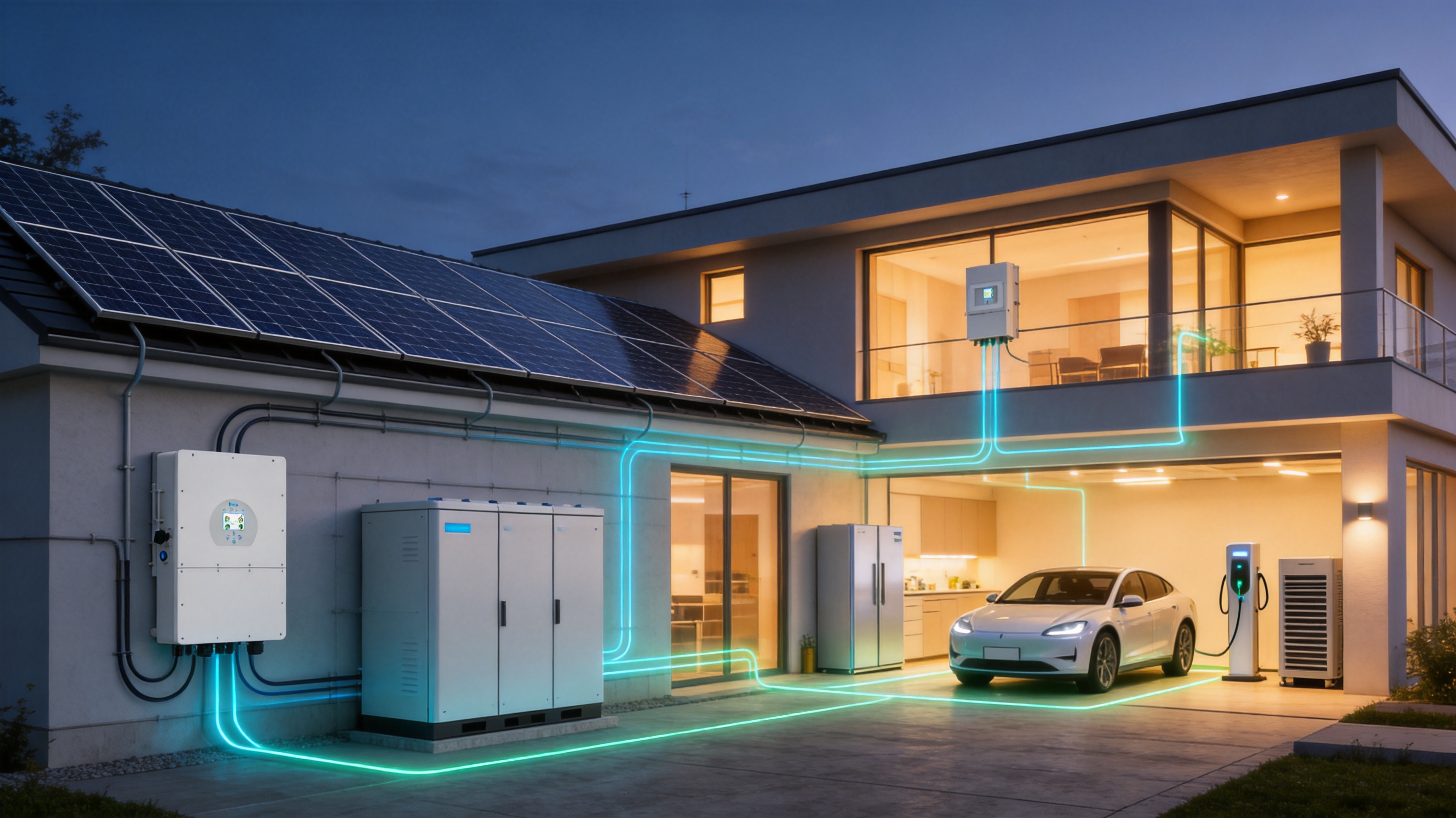
A hybrid inverter is most valuable when its operating logic matches the customer’s energy objectives. The SUN-(5-25)K-SG01HP3-EU-AM2 can be configured for several broad strategies, subject to firmware, battery compatibility, and local installation settings.
Solar self-consumption
In self-consumption mode, photovoltaic power is first directed toward active loads. Excess solar power can charge the battery, and any remaining surplus may be exported to the grid if export is permitted. When solar production falls, the battery can discharge to supply loads before grid power is used.
This arrangement increases the value of locally generated electricity. Instead of exporting all midday production and purchasing electricity later in the evening, the customer can shift a portion of solar energy to the time when it is most useful.
Time-of-use operation
With six programmable charging and discharging periods, the inverter can be configured for tariff-based operation. The battery may charge from solar or the grid during a low-cost period and discharge during a higher-cost period.
Time-of-use operation should be optimized carefully. Excessive cycling may increase battery wear, while overly conservative settings may leave useful storage capacity unused. The ideal schedule depends on the battery’s usable energy, round-trip efficiency, tariff difference, expected solar production, and backup reserve requirement.
Backup reserve
The battery can be reserved at a defined minimum state of charge for emergency operation. Under normal conditions, the inverter can use energy above this reserve for self-consumption or tariff management. If the grid fails, the reserved energy remains available for protected loads.
A higher reserve improves outage preparedness but reduces the amount of battery capacity available for daily savings. A lower reserve may improve routine economic performance but provide less backup duration. The correct setting depends on the reliability of the local grid and the importance of the connected loads.
Generator-assisted charging
Where a generator is available, the inverter can coordinate generator energy with battery storage. The generator may support active loads while excess capacity charges the battery. Once the battery reaches the configured target, the generator can be stopped or returned to standby, depending on the control arrangement.
This mode can be particularly useful for remote facilities, agricultural sites, telecommunications locations, and buildings where grid interruptions are frequent. Solar generation can reduce fuel consumption during daylight, while the battery can reduce generator runtime during low-load periods.
Protection, Safety, and Reliability Features
Safety is a central requirement for a high-power energy storage inverter. The product includes a range of integrated protection functions covering DC, AC, thermal, insulation, residual current, and anti-islanding conditions.
Integrated DC reverse-polarity protection helps prevent damage if photovoltaic or battery connections are made with incorrect polarity. AC output overcurrent protection and short-circuit protection help protect the inverter and connected circuits during abnormal current events.
Thermal protection monitors internal operating conditions and can reduce output or disconnect the system if temperatures exceed safe limits. The stated operating temperature range is -40°C to +60°C, with derating above 45°C. Derating is an important consideration for installations in hot climates or locations with limited ventilation.
Anti-islanding protection is required for grid-connected systems. If the utility supply fails, the inverter must stop energizing the grid in accordance with applicable interconnection rules. This protects utility personnel and helps prevent unsafe energization of a supposedly disconnected network.
Insulation impedance detection and residual current detection provide additional protection against leakage and insulation faults. DC component monitoring helps identify abnormal direct-current injection into the AC network.
An arc fault circuit interrupter is listed as optional. Arc detection can be valuable in PV systems because a persistent electrical arc may create a serious thermal hazard. Whether this feature is required depends on local codes, project design, and the applicable certification framework.
The inverter includes a DC switch and Type II surge protection on both the DC and AC sides. Surge protection helps limit transient overvoltage caused by switching events or lightning-induced disturbances, although external surge protection and appropriate grounding may still be required for the complete installation.
Ingress and environmental protection
The enclosure has an IP65 ingress protection rating. This indicates protection against dust ingress and water jets from various directions, making the unit suitable for many indoor and outdoor installation environments when installed according to the manufacturer’s requirements.
The permissible ambient humidity is listed as 0% to 100%, and the permissible altitude is 2,000 meters. Installations above the stated altitude may require derating or confirmation from the manufacturer. Humid, coastal, dusty, and chemically aggressive environments should be evaluated carefully because enclosure protection does not eliminate the effects of condensation, salt mist, or corrosive gases.
Noise is specified at no more than 55 dB(A). The smaller models use natural cooling, while certain larger models use intelligent air cooling. Natural cooling can reduce moving parts and maintenance requirements, whereas intelligent fan control can provide effective thermal management when power density increases.
Efficiency and Power Conversion Quality
The maximum efficiency of the series is specified at 97.6%, with European efficiency of 97.0% and MPPT efficiency above 99%. These figures describe the effectiveness of the power conversion and solar tracking process under defined test conditions.
High efficiency reduces conversion losses and helps more of the available solar energy reach the loads or battery. However, system designers should distinguish between peak efficiency and weighted daily energy performance. Real-world output is affected by temperature, partial loading, battery state of charge, cable losses, standby consumption, shading, and grid conditions.
The MPPT efficiency above 99% indicates that the tracker can closely follow the available operating point of the PV array. This is particularly important during variable irradiance conditions, when cloud movement, shading, and changing module temperature continuously alter the ideal operating voltage.
The combination of high conversion efficiency and high-voltage battery operation can help improve the total performance of the energy storage system. Reduced current on the battery side can also contribute to lower resistive losses in correctly sized conductors and connections.
Communication, Monitoring, and System Visibility
The inverter provides RS485, RS232, and CAN communication interfaces. These interfaces support communication with batteries, meters, external control devices, and monitoring equipment, depending on the selected system architecture.
CAN communication is commonly used for battery management system integration. It can allow the battery to report state of charge, maximum permitted charge current, maximum permitted discharge current, temperature, alarms, and other operating information. BMS communication is essential for safe and coordinated lithium-ion battery operation.
RS485 can be used for meters, data loggers, and system-level communication. RS232 may support specific local devices or service functions. The exact use of each interface should follow the product documentation and approved wiring diagrams.
Optional monitoring methods include GPRS, Wi-Fi, Bluetooth, 4G, and LAN. This selection enables different connectivity strategies. Wi-Fi may be practical in a building with reliable network coverage, while 4G or GPRS can be more suitable for remote sites. LAN can provide a stable wired connection where network infrastructure is available.
The LCD display provides local access to operating information, settings, alarms, and system status. Local visibility remains important even when cloud monitoring is available because installers and operators may need to inspect the inverter during commissioning or a network outage.
Digital monitoring can help users identify solar production, battery charging and discharging, grid import and export, load consumption, fault codes, and historical performance. Better visibility supports preventive maintenance and helps confirm whether the system is operating according to its intended energy strategy.
Advantages Compared with Conventional Alternatives
The product offers several advantages over a basic string inverter. A conventional string inverter may provide efficient solar-to-grid conversion, but it normally requires additional equipment for battery storage and backup power. The hybrid architecture integrates these functions into one coordinated platform.
Compared with low-voltage storage systems, the high-voltage battery input can support lower current at higher power levels. This can simplify high-power battery integration and reduce certain conduction losses when the system is correctly designed.
Compared with single-phase hybrid inverters, the three-phase design is better suited to properties with three-phase electrical service, three-phase motors, and distributed commercial loads. The ability to handle 100% unbalanced output provides an additional practical advantage in installations where phase loads are not evenly distributed.
Compared with fixed-capacity systems, support for up to ten parallel inverters creates a clearer path for expansion. Customers can increase output capacity without abandoning the original system architecture, although the electrical infrastructure and control design must support the expansion.
Compared with storage systems that accept only solar or grid charging, the generator charging function provides more flexibility for weak-grid and off-grid projects. The inverter can become part of a broader energy system that includes PV, batteries, the utility, and a diesel generator.
Compared with retrofit solutions that require removal of an existing PV inverter, AC coupling can preserve the investment in existing solar equipment. This may reduce project disruption and help extend the useful life of an installed PV system.
Manufacturing Strengths and Engineering Capability
Ningbo Deye Inverter Technology Co., Ltd. presents itself as a comprehensive technology manufacturing enterprise integrating research and development, design, production, sales, and service. This integrated structure supports continuous development across hardware, firmware, testing, certification, manufacturing, and after-sales support.
The company’s product portfolio includes photovoltaic inverters, energy storage inverters, microinverters, battery energy storage systems, commercial and industrial storage solutions, electric vehicle charging solutions, and environmental appliances. A broad portfolio can encourage the reuse of engineering knowledge across product families, including power electronics, thermal management, communications, safety protection, and digital monitoring.
Manufacturing strength is not limited to assembly volume. For an inverter manufacturer, quality depends on the entire process chain: component qualification, printed circuit board assembly, power semiconductor installation, thermal interface control, enclosure production, firmware loading, calibration, electrical safety testing, functional testing, and final inspection.
Advanced production should include controlled handling of sensitive electronic assemblies and traceability for critical components. Automated or semi-automated processes can improve repeatability, while in-process inspection can identify soldering, placement, torque, connector, and wiring issues before final testing.
Power electronics manufacturing also requires careful attention to thermal paths. Heat generated by switching devices must be transferred efficiently to heatsinks or cooling structures. Incorrect thermal interface application, loose fasteners, contamination, or inadequate airflow can reduce long-term reliability. The product’s natural-cooling and intelligent-air-cooling configurations indicate that thermal architecture is adapted to different power levels.
End-of-line testing is particularly important for hybrid inverters because the unit contains multiple operating sections. A comprehensive test program may verify PV input behavior, battery charging, battery discharging, AC conversion, bypass operation, grid synchronization, backup transition, communication ports, protection functions, alarms, and display operation.
Safety and compliance testing also support international deployment. The product documentation identifies standards and grid regulations including IEC 61727, IEC 62116, CEI 0-21, EN 50549, NRS 097, RD 140, UNE 217002, OVE-Richtlinie R25, G98, G99, and VDE-AR-N 4105. It also identifies IEC and EN 61000-6-1, 61000-6-2, 61000-6-3, 61000-6-4, IEC/EN 62109-1, and IEC/EN 62109-2 for safety and electromagnetic compatibility.
Certification does not remove the need for local engineering review, but it demonstrates that the product family is designed for multiple regulatory environments. The availability of country-specific certificates can simplify documentation for distributors, installers, and project developers.
The company’s international reach, with products sold across more than 140 countries and regions according to the supplied company information, also provides exposure to a wide variety of climate conditions, grid standards, installation practices, and customer requirements. That experience can support product refinement and application knowledge.
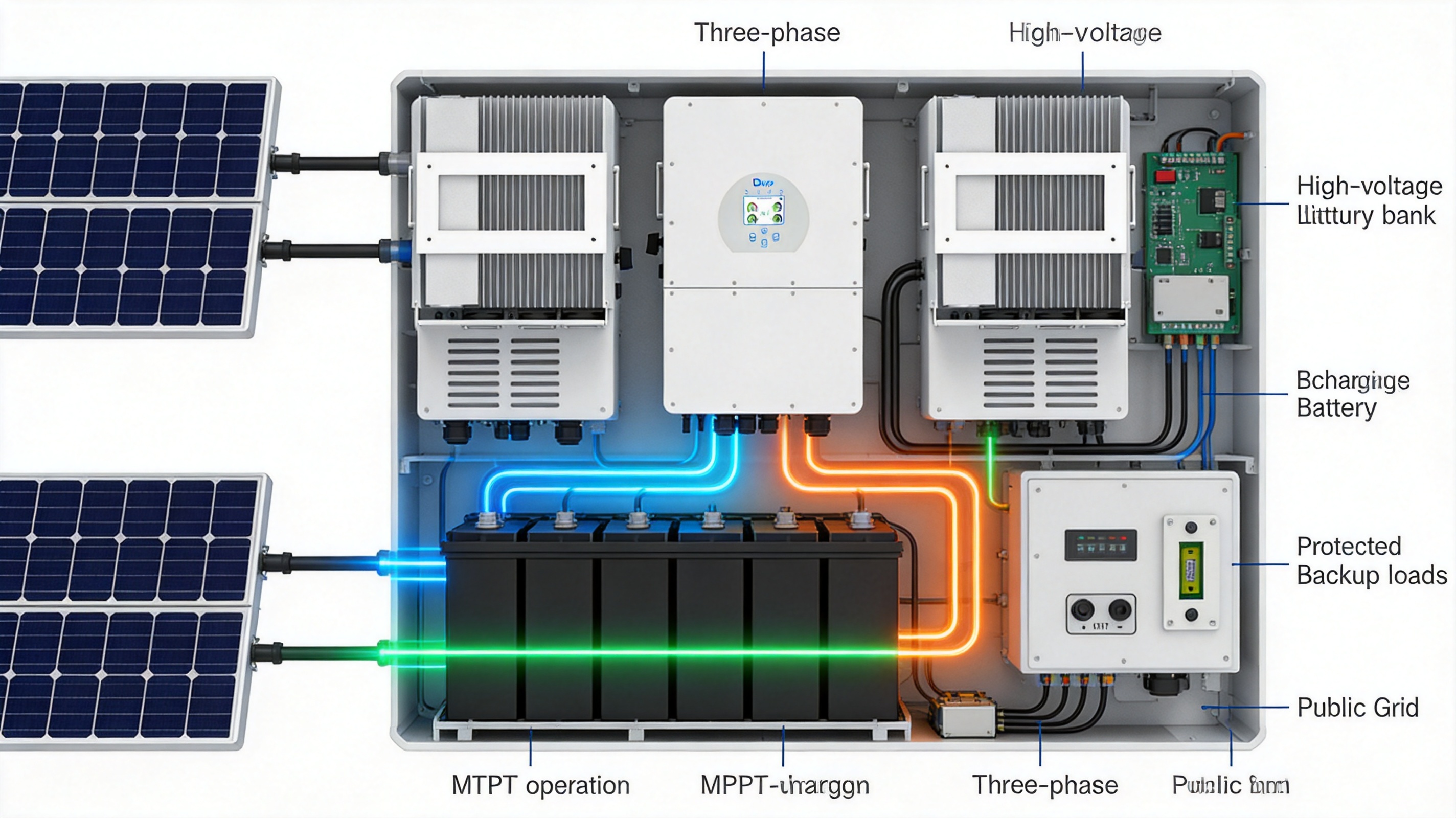
Installation Planning Considerations
A successful installation begins with a detailed load assessment. The designer should record continuous loads, peak loads, motor starting currents, phase distribution, daily operating hours, and the loads that must remain available during a power outage.
PV string design should consider the maximum open-circuit voltage at the lowest expected module temperature and the maximum operating current under high irradiance. The designer must keep voltage and current within the stated input limits, including the effect of parallel strings and module tolerances.
Battery design should consider nominal voltage, usable capacity, continuous current, peak current, battery management communication, temperature limits, installation clearance, and expansion plans. The 160 V to 700 V battery range should not be interpreted as permission to combine arbitrary battery modules. Only compatible and approved batteries should be used.
AC protection must be selected according to the inverter’s rated and maximum currents, local regulations, cable capacity, fault levels, and installation method. The grid connection, backup output, generator connection, and battery circuits may require separate disconnects, overcurrent protection, surge protection, and residual current protection.
Because the inverter is non-isolated, the grounding and insulation strategy must be carefully reviewed. The installation should follow the specified neutral, protective earth, DC isolation, and equipotential bonding arrangements.
The operating environment also matters. Although the unit is IP65 rated and designed for a wide temperature range, it should not be installed in a location exposed to persistent flooding, corrosive vapors, direct heat sources, blocked airflow, or excessive dust. Adequate clearance is required for servicing and cooling.
Parallel systems need additional planning for synchronization, communication, load sharing, and fault coordination. The installer should commission the system in stages, beginning with individual units and communications before applying full load or expanding the system.
Commercial and Financial Value
The financial value of a hybrid inverter depends on how effectively it aligns energy production with consumption. A system that charges during solar availability and supplies evening loads can increase on-site use of PV energy. A system configured for time-of-use tariffs may reduce purchases during expensive periods.
Backup capability also has economic value, even when the grid is normally reliable. Avoiding production losses, refrigeration failures, data interruptions, or business downtime may justify storage for commercial users. For residential users, the value may be measured through comfort, security, and continuity of essential services.
AC coupling can reduce retrofit costs by allowing existing solar equipment to remain in service. Parallel capability can reduce the need for excessive initial investment because output capacity can be expanded later. These benefits should be evaluated against battery cost, installation complexity, utility requirements, maintenance, financing, and expected operating life.
System owners should avoid assessing an inverter only by its maximum efficiency or nominal power. The complete business case should include battery capacity, usable depth of discharge, expected cycling, electricity tariffs, export compensation, demand charges, generator fuel savings, maintenance, replacement planning, and software or communications requirements.
Recommended Use Cases
Large residential property
A large residence may have a three-phase connection, a rooftop PV array, heat pumps, water pumps, kitchen appliances, electric vehicle charging, and substantial evening consumption. The inverter can direct solar power to loads, charge a high-voltage battery, and provide backup to selected household circuits.
Small commercial building
An office, retail store, or restaurant may consume electricity during the day but experience high demand during tariff peaks. The inverter can use solar power directly, store surplus generation, and discharge the battery when electricity prices or demand charges rise.
Farm or agricultural facility
A farm may require power for irrigation, ventilation, refrigeration, and workshops. The three-phase output and generator charging function can help coordinate different sources of power, while battery storage can support critical operations during grid interruptions.
Existing solar retrofit
A customer with an operational PV inverter may want battery storage without replacing the original system. AC coupling enables a storage upgrade while preserving much of the existing solar installation, subject to compatibility and local approval.
Weak-grid or remote site
A remote site can combine PV, a high-voltage battery, a diesel generator, and backup loads. Solar energy can reduce generator runtime, while stored generator energy can support loads after the generator has stopped.
Limitations and Responsible System Design
No inverter can compensate for an incorrectly sized PV array, undersized battery, poor cable installation, inadequate ventilation, or an unsuitable load profile. The product’s capabilities must be matched to the actual project.
The maximum output power is not the same as the maximum energy storage capacity. Power determines how much load can be supplied at one time, while battery capacity determines how long the load can be supplied. A 25 kW inverter with a small battery may support high short-term power but provide limited backup duration.
Similarly, parallel operation does not mean that any number of units can be connected without additional infrastructure. Switchgear, cables, protection, battery capacity, communications, and distribution equipment must all be sized for the expanded system.
Performance above 45°C may be reduced because the inverter derates at higher temperatures. Installers in hot climates should consider shade, airflow, mounting location, and realistic operating conditions.
Country-specific grid rules may impose additional requirements for export control, protection settings, phase imbalance, generator connection, or certification. The product’s listed standards provide a foundation, but final approval remains subject to the local utility and authority having jurisdiction.
Frequently Asked Questions
What type of inverter is the SUN-(5-25)K-SG01HP3-EU-AM2?
It is a three-phase high-voltage hybrid inverter family with rated power options from 5 kW to 25 kW. It can work with photovoltaic modules, lithium-ion batteries, the utility grid, backup loads, and compatible diesel generator systems.
What battery voltage range does it support?
The stated battery voltage range is 160 V to 700 V. Battery selection must also satisfy the permitted charging and discharging current, BMS communication requirements, temperature limits, and approved compatibility list.
Can the inverter work with an existing solar system?
Yes. The product supports AC coupling for retrofitting an existing solar installation. The original PV inverter, wiring, protection, grid configuration, and export-control requirements must be evaluated before installation.
How many inverters can operate in parallel?
Up to ten units can operate in parallel for on-grid and off-grid applications, according to the supplied product information. Parallel installations must follow the manufacturer’s communication, synchronization, protection, and commissioning procedures.
Can the inverter support unbalanced loads?
Yes. The product is specified as supporting 100% unbalanced output, which is useful for three-phase properties where single-phase loads are not evenly distributed.
Can batteries be connected in parallel?
Multiple batteries can be connected in parallel when permitted by the battery manufacturer and the approved system design. Battery voltage, current, state of charge, communication, protection, and cable sizing must be checked carefully.
How many battery charge and discharge schedules are available?
The inverter supports six time periods for battery charging and discharging. These periods can be used to create schedules for solar charging, tariff management, self-consumption, and backup reserve operation.
Can a diesel generator charge the battery?
Yes. The inverter supports storing energy from a diesel generator. Generator voltage, frequency, capacity, grounding, control signals, and changeover arrangements must be compatible with the complete system.
What is the maximum PV input voltage?
The maximum PV input voltage is specified as 1,000 V, with a startup voltage of 180 V and an MPPT voltage range of 150 V to 850 V. String voltage must remain within the limits under the full expected temperature range.
How many MPPTs does the inverter have?
The product family has two MPPTs. Depending on the model, the listed string arrangement is 2/1+1, 2/2+1, or 2/2+2. The final arrangement must be matched to the selected model and PV design.
What communications options are available?
The inverter provides RS485, RS232, and CAN interfaces. Optional monitoring methods include GPRS, Wi-Fi, Bluetooth, 4G, and LAN. A local LCD is also provided.
What protection functions are included?
Integrated functions include DC reverse-polarity protection, AC overcurrent protection, thermal protection, AC overvoltage protection, AC short-circuit protection, DC component monitoring, anti-islanding protection, a DC switch, insulation impedance detection, and residual current detection. Arc fault interruption is listed as optional.
What is the enclosure protection rating?
The inverter has an IP65 rating. It is designed for suitable indoor or outdoor installations, but the mounting location must still provide appropriate clearance, temperature control, protection from flooding, and access for service.
What standards and grid regulations are identified for the product?
The supplied documentation identifies a range of standards and regulations, including IEC 61727, IEC 62116, EN 50549, CEI 0-21, G98, G99, VDE-AR-N 4105, IEC/EN 62109-1, IEC/EN 62109-2, and several country-specific requirements. The applicable approval depends on the installation location.
What warranty period is provided?
The stated warranty is five years, with extension up to ten years in some cases. The actual period varies by installation country and should be confirmed through the applicable warranty policy.
Conclusion
The SUN-(5-25)K-SG01HP3-EU-AM2 is positioned as a flexible three-phase hybrid inverter for solar generation, high-voltage battery storage, backup power, and multi-source energy management. Its principal strengths include a broad 5 kW to 25 kW power range, two MPPTs, 160 V to 700 V battery compatibility, 100% unbalanced output, AC-coupling capability, six battery scheduling periods, generator energy storage, and parallel operation of up to ten units.
These functions make the product suitable for new installations and retrofit projects across residential, agricultural, commercial, and weak-grid applications. Its high-voltage architecture supports efficient power transfer, while its communication, monitoring, protection, and grid-compliance features provide the foundation for a modern energy management system.
The manufacturing and engineering capabilities of Ningbo Deye Inverter Technology Co., Ltd. further support the product’s market position. Experience across photovoltaic inverters, energy storage, power electronics, monitoring, and international certification contributes to a product platform designed for diverse operating environments.
The best results will come from careful project design. Load analysis, PV string calculation, battery compatibility, protective devices, thermal conditions, grid rules, generator integration, and commissioning procedures must all be addressed. When these elements are correctly coordinated, the inverter can help users improve solar self-consumption, reduce dependence on expensive grid electricity, maintain backup power, and build an energy system that can expand over time.
References
1. Product datasheet: SUN-(5-25)K-SG01HP3-EU-AM2, Three Phase Hybrid Inverter, 5-25 kW.
2. Product installation and operation manual: SUN-5-25K-SG01HP3-EU-AM2.
3. IEC 62109-1, Safety of Power Converters for Use in Photovoltaic Power Systems, General Requirements.
4. IEC 62109-2, Safety of Power Converters for Use in Photovoltaic Power Systems, Particular Requirements for Inverters.
5. IEC 61727, Photovoltaic Systems—Utility Interface Characteristics.
6. IEC 62116, Utility-Interconnected Photovoltaic Inverters—Test Procedure of Islanding Prevention Measures.
7. EN 50549, Requirements for Generating Plants to Be Connected in Parallel with Distribution Networks.
8. IEC 61000 series, Electromagnetic Compatibility Requirements.
9. Manufacturer technical documentation for high-voltage battery integration, monitoring, grid connection, and parallel operation.
Product: SUN-5/6/8/10/12/15/20/25K-SG01HP3-EU-AM2

PREV:Module-Level Solar Optimization for Higher Yield, Safer Shutdown, and Smarter PV Monitoring
NEXT:Advanced Three-Phase String Inverter for High-Performance Commercial Solar Systems
Share
Product recommendations
news recommendations
-
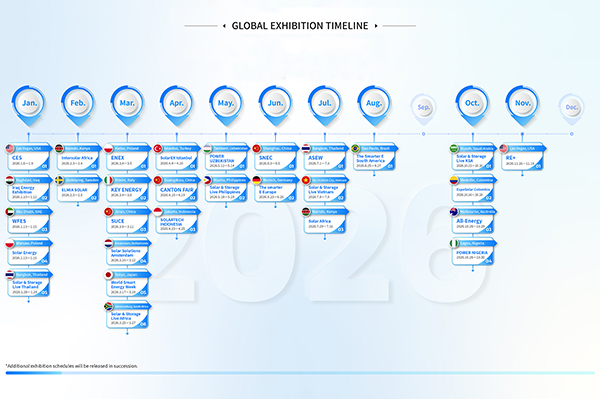 GLOBAL EXHIBITION TIMELINE
*Click to view larger image
-
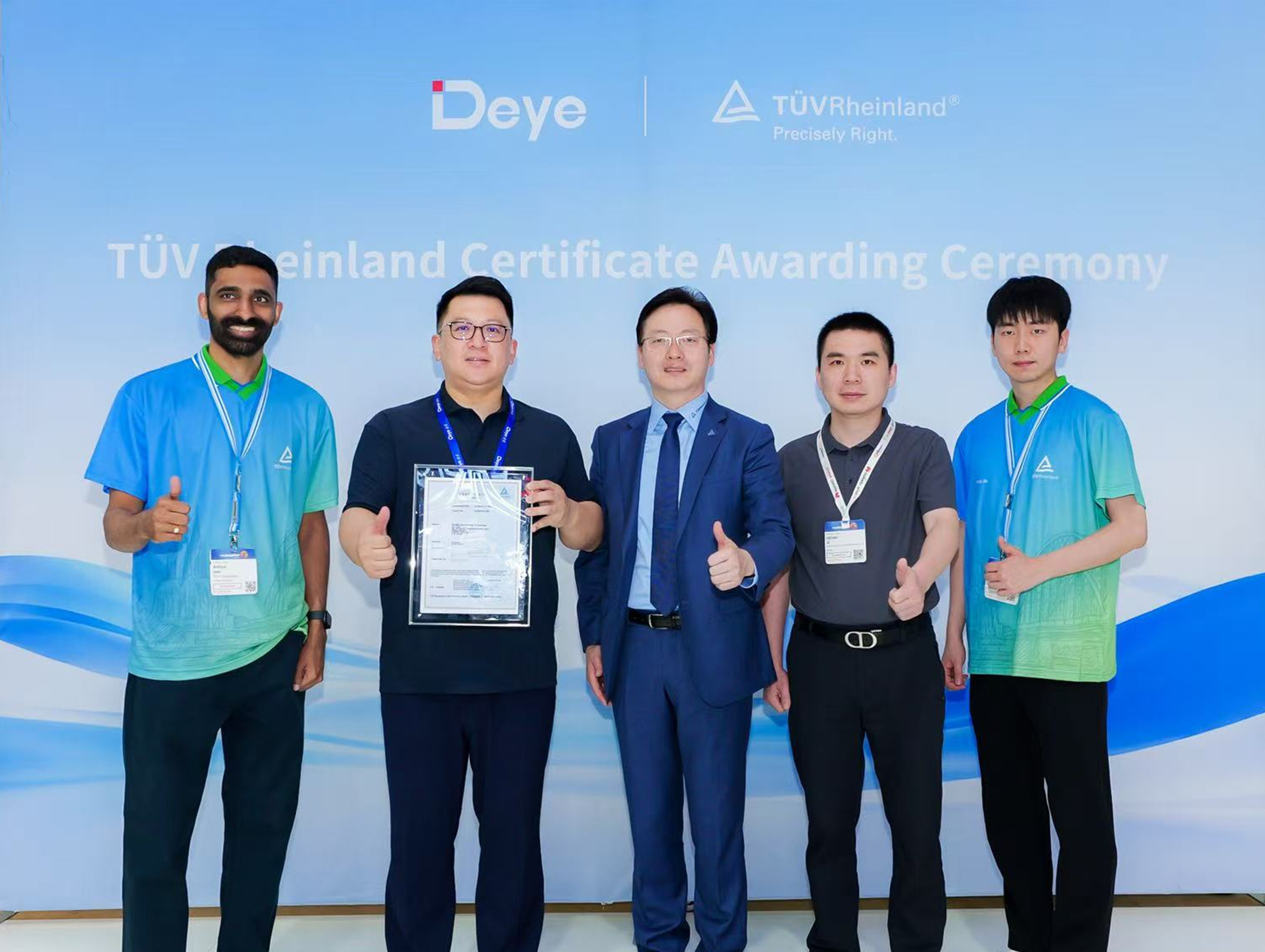 Deye Secures Multiple TÜV Rheinland Certifications at The smarter E Europe
On June 23, the opening day of The smarter E Europe 2026, Deye was officially awarded several presti...
-
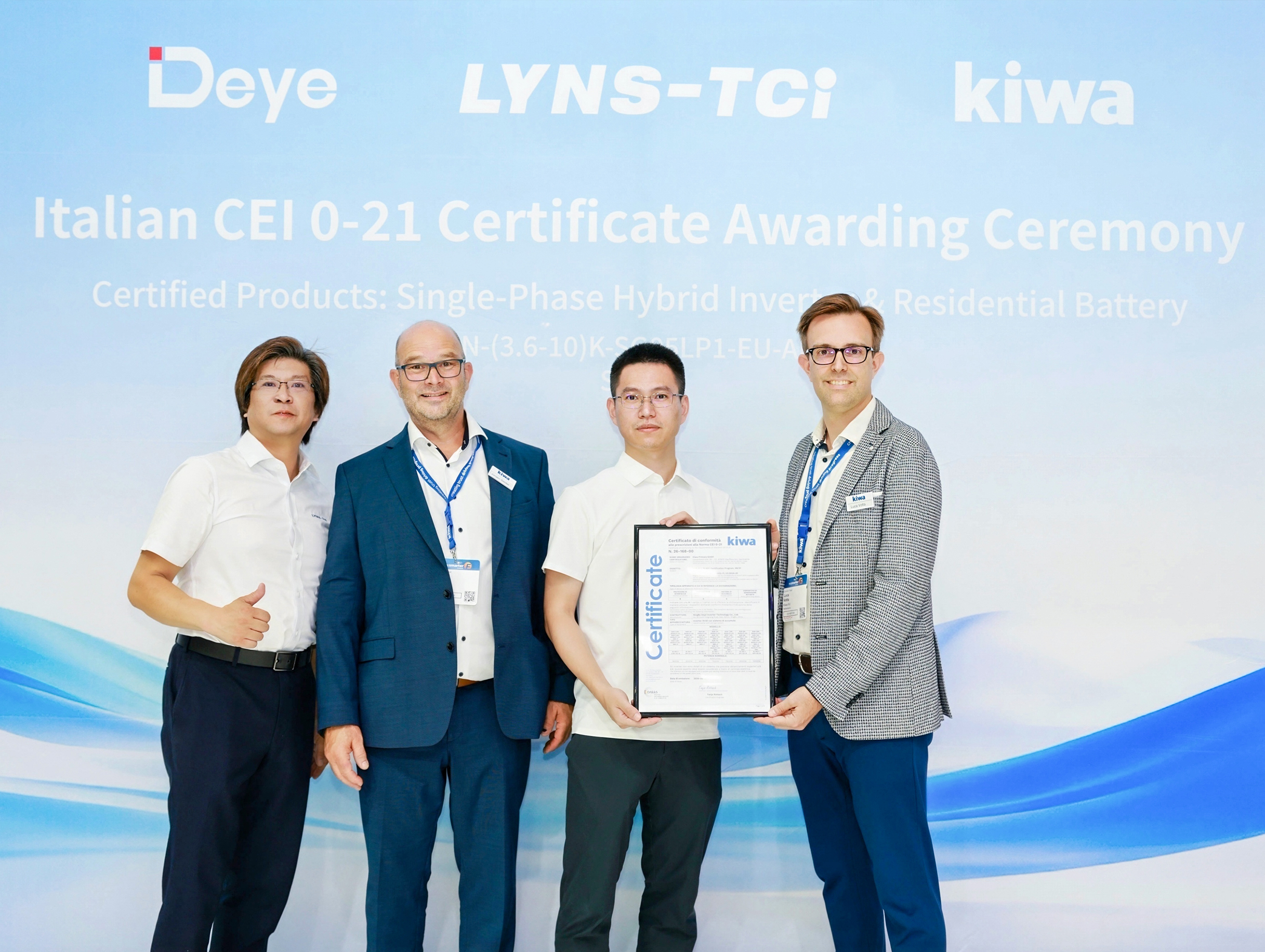 Deye Next-Gen Residential Energy Storage Products Receive Italian CEI 0-21 Certification from Kiwa
At The smarter E Europe 2026, Deye, a leading supplier of inverters and energy storage solutions, of...

Copyright@ 2024.Ningbo Deye Inverter Technology Co.,Ltd. All rights reserved. Solar Inverter Manufacturer
