
 Online Shop
 English
 China - 简体中文
 Global - English
 Brazil - Português
 Netherlands - Dutch
 Italy - Italiano
 Germany - Deutsch
 Spain - Español
 France - Français
 Vietnam - Tiếng Việt
 Poland - Polski
 Australia - English
 Japan - 日本語
Luo Qinxue — Regional Sales Manager, On-Grid Inverter Solutions

High-Power Three-Phase String Inverters for Modern Commercial Solar Plants
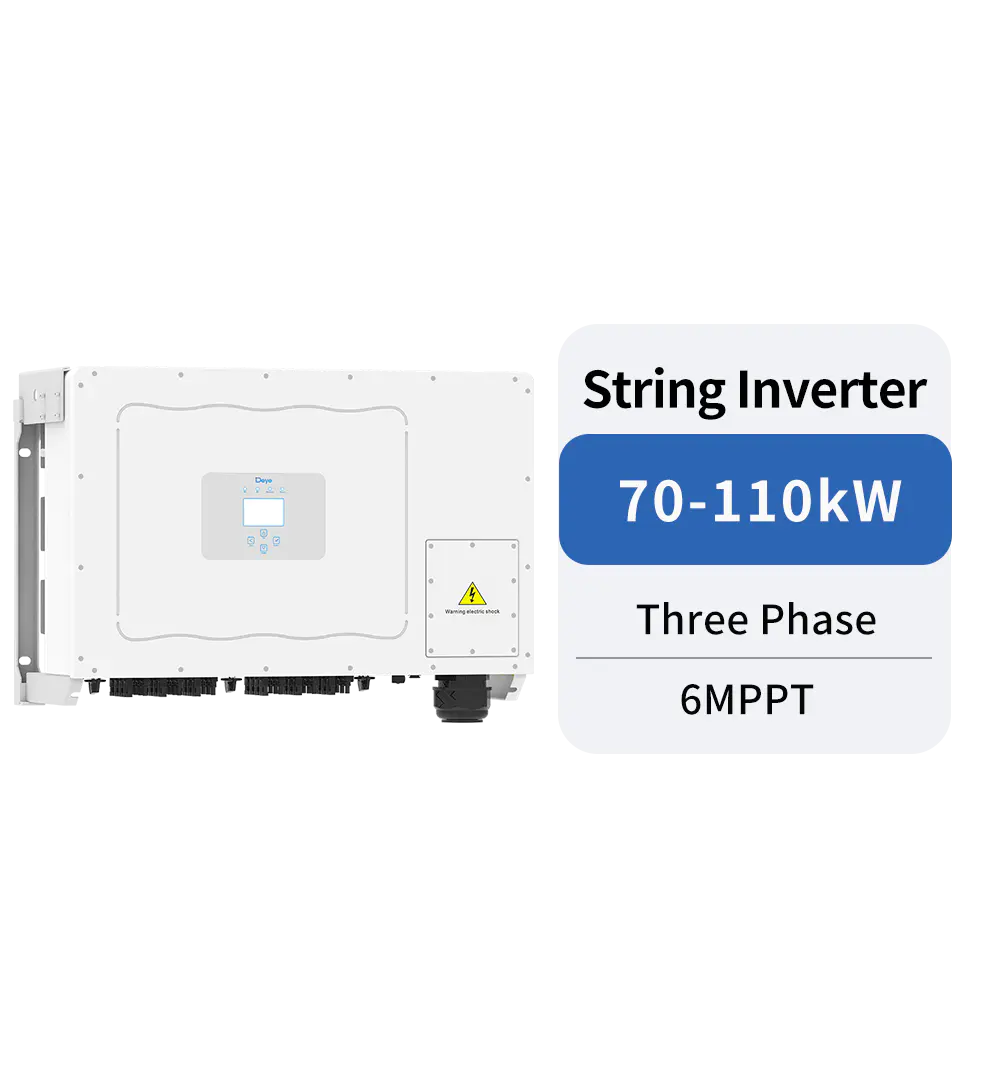
Large commercial and industrial photovoltaic systems require more than basic DC-to-AC conversion. They need high power density, flexible array design, dependable grid interaction, effective protection, accurate monitoring, and a design that can continue operating efficiently under changing environmental and electrical conditions. The SUN-70/75/80/90/100/110K-G03 series is designed for these requirements as a family of three-phase string inverters covering rated output powers from 70 kW to 110 kW.
With up to six maximum power point trackers, a maximum efficiency of up to 98.8%, a wide MPPT voltage range, integrated Type II surge protection, and support for advanced functions such as zero export and virtual synchronous generator operation, the series is positioned for demanding commercial and industrial solar installations. Its architecture gives system designers the flexibility to manage multiple roof orientations, uneven string layouts, partial shading conditions, and large-scale distributed generation projects.
The product family is manufactured by Ningbo Deye Inverter Technology Co., Ltd., a technology manufacturing enterprise active in photovoltaic inverters, energy storage systems, environmental appliances, and energy management solutions. The company integrates research and development, product design, production, sales, and service. Its broad product portfolio includes string inverters, energy storage inverters, microinverters, commercial and industrial energy storage systems, and related monitoring technologies.
This article examines the technical characteristics of the SUN-(70-110)K-G03 series, its value in comparison with conventional high-power inverter approaches, and the manufacturing and engineering capabilities that support its use in commercial solar applications.
1. Product Overview and Application Positioning
The SUN-70/75/80/90/100/110K-G03 is a three-phase grid-connected string inverter platform. Instead of relying on one large centralized conversion unit for an entire solar plant, a string inverter architecture divides the array into manageable electrical groups. Each inverter receives power from multiple PV strings and converts it into synchronized three-phase AC power for connection to the utility grid.
The series includes six nominal power options: 70 kW, 75 kW, 80 kW, 90 kW, 100 kW, and 110 kW. This range allows installers and system designers to select a suitable inverter size without changing to a completely different platform. The result can be a more consistent engineering process across rooftop, ground-mounted, agricultural, commercial, and light industrial projects.
The inverter is intended for systems using a three-phase, four-wire grid connection with protective earthing. Its rated output voltage supports 220/380 V and 230/400 V systems, with an operating range of 0.85 to 1.1 times the nominal voltage. It supports both 50 Hz and 60 Hz grid applications within the stated frequency ranges of 45–55 Hz and 55–65 Hz.
The product is particularly suitable for installations that require:
• High AC output power from a compact string inverter platform.
• Multiple independent MPPT channels for complex PV layouts.
• Compatibility with commercial low-voltage three-phase grids.
• String-level monitoring as an optional function.
• Export limitation and zero-export operation.
• Grid-support functions such as VSG operation.
• Integrated DC and AC surge protection.
• Outdoor installation with an IP65 enclosure.
• Remote monitoring through optional communication devices.
By combining these features in one product family, the series addresses the practical demands of commercial solar deployment rather than focusing only on nominal conversion power.
2. Power Range and Electrical Configuration
The six models cover a broad range of output requirements. The rated active power begins at 70 kW and rises to 110 kW. Maximum apparent power ranges from 77 kVA for the 70 kW model to 121 kVA for the 110 kW model. This apparent power margin supports reactive power control and gives the inverter additional flexibility in grid-support applications.
| Model | Rated Active Power | Maximum Apparent Power | Maximum PV Input Power |
|---|---|---|---|
| SUN-70K-G03 | 70 kW | 77 kVA | 91 kW |
| SUN-75K-G03 | 75 kW | 82.5 kVA | 97.5 kW |
| SUN-80K-G03 | 80 kW | 88 kVA | 104 kW |
| SUN-90K-G03 | 90 kW | 99 kVA | 135 kW |
| SUN-100K-G03 | 100 kW | 110 kVA | 150 kW |
| SUN-110K-G03 | 110 kW | 121 kVA | 150 kW |
The maximum PV input power is higher than the rated AC output power for every model. This supports DC oversizing, a common design practice used to improve annual energy yield by allowing the array to produce more energy during low-irradiance periods. The available DC-to-AC ratio depends on the selected model and the project design conditions.
For the 70 kW model, the maximum PV input power is 91 kW. For the 75 kW and 80 kW models, the corresponding values are 97.5 kW and 104 kW. The 90 kW model accepts up to 135 kW of PV input, while both the 100 kW and 110 kW versions are listed with a maximum PV input power of 150 kW.
Proper system design remains essential. The actual DC oversizing ratio should consider local irradiance, module temperature coefficients, clipping expectations, string voltage, installation orientation, grid limitations, and the inverter’s operating instructions.
3. Six MPPT Architecture and Array Design Flexibility
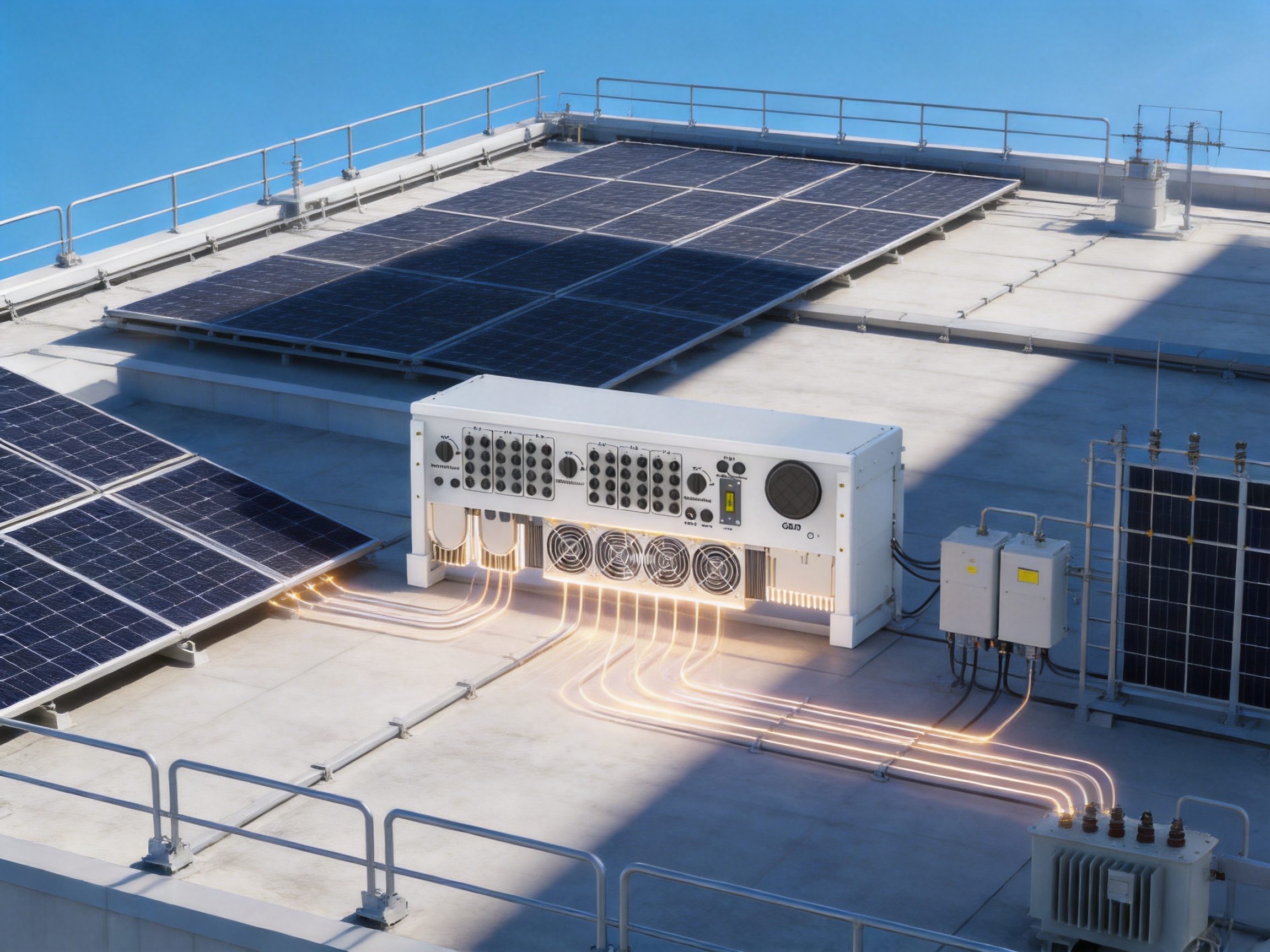
One of the most important advantages of the platform is its multi-MPPT design. Depending on the model configuration, the inverter provides four or six maximum power point trackers. The six-MPPT versions are arranged with four strings per tracker, while the four-MPPT configuration is also specified with four strings per tracker.
Each MPPT independently tracks the voltage at which its connected PV strings produce the highest power. This is valuable when different sections of an array have different orientations, tilt angles, module types, or shading conditions. Rather than forcing all strings to operate at one common electrical point, the inverter can optimize separate groups.
In practical terms, six MPPT channels can offer several benefits:
• Better adaptation to multi-roof commercial buildings.
• More flexible use of east-facing, south-facing, and west-facing roof areas.
• Reduced mismatch between strings exposed to different shading patterns.
• Simplified design for arrays with multiple roof elevations or azimuths.
• Easier expansion of existing commercial PV systems.
• More efficient use of available roof space when a uniform array layout is impossible.
Conventional high-power designs with fewer MPPT channels may require additional string grouping, external combiner equipment, or stricter layout uniformity. A higher MPPT count can reduce these constraints and make the engineering process more adaptable.
The inverter has a maximum PV input voltage of 1,000 V, a start-up voltage of 250 V, and an MPPT operating range of 200–850 V. The rated PV input voltage is 600 V. These values give designers a broad operating window for selecting module quantities per string while maintaining suitable voltage margins under cold and hot conditions.
String sizing must always be based on the module open-circuit voltage at the lowest expected site temperature and the module operating voltage at the highest expected temperature. The maximum voltage must remain below the inverter limit, while the operating voltage should remain within the MPPT window during normal production.
4. Conversion Efficiency and Energy Yield
Efficiency is directly connected to the amount of solar energy delivered to the grid. Even a small reduction in conversion efficiency can represent a significant annual energy loss in a large commercial plant. The SUN-(70-110)K-G03 series specifies a maximum efficiency of up to 98.8%, with the product data showing maximum efficiency values of 98.70% and 98.80% across the listed model groupings.
The stated European efficiency values reach 98.10% and 98.20%, while MPPT efficiency is specified as greater than 99%. Maximum efficiency indicates the best conversion point under favorable operating conditions. European efficiency is intended to represent performance over a weighted range of operating conditions and can be more meaningful for estimating annual energy behavior.
High efficiency is supported by several design elements:
• A non-isolated inverter topology that avoids some conversion losses associated with unnecessary isolation stages.
• Wide MPPT operation that helps the system remain productive across changing array voltage conditions.
• Intelligent air cooling designed to manage thermal conditions.
• Digital control of the DC-to-AC conversion process.
• A multi-channel tracking system that helps reduce mismatch losses between array sections.
In comparison with less flexible inverter platforms, the combination of high peak efficiency and multiple MPPT channels can improve real-world system performance, especially on commercial roofs where the PV array cannot always be installed in one ideal orientation.
Efficiency should not be evaluated in isolation. A complete assessment should also include nighttime consumption, standby behavior, thermal derating, cable losses, transformer losses, clipping, and the effects of local grid operation. Nevertheless, the stated efficiency levels place the series among the high-performance options for its power class.
5. Grid Support and Power Quality Functions
Modern grid-connected inverters must do more than deliver active power. Distribution networks increasingly require control of reactive power, voltage response, frequency behavior, and export limits. The series supports a power factor adjustment range from 0.8 leading to 0.8 lagging. This allows the inverter to provide reactive power control when required by the project or grid operator.
The total current harmonic distortion is specified at less than 3%. Low harmonic distortion helps maintain power quality and reduces the possibility of adverse effects on other electrical equipment. The specified DC injection current is less than 0.5% of the rated current, supporting compatibility with transformerless grid-connected operation when correctly installed.
Zero-export application is another important feature. In a zero-export system, the inverter is controlled so that generated power is consumed locally or directed to an energy storage system rather than being exported to the utility grid. This can be useful where regulations limit feed-in, where a facility wants to avoid reverse power flow, or where the electrical connection has a restricted export capacity.
Accurate export control generally requires appropriate metering and a correctly configured energy management system. The inverter itself is one part of the complete solution; current transformers, meters, communications, site loads, and control settings must all be properly selected and installed.
The product also supports VSG application. Virtual synchronous generator operation is designed to provide grid-support characteristics that resemble certain behaviors of traditional synchronous generators, such as controlled response to grid frequency or voltage conditions. This function can be valuable in systems with a high penetration of inverter-based generation, although the exact operating behavior depends on the project configuration, firmware, grid code, and commissioning settings.
The series lists compliance with multiple grid regulations and standards, including IEC 61727, IEC 62116, CEI 0-21, EN 50549, NRS 097, RD 140, UNE 217002, OVE-Richtlinie R25, G99, and VDE-AR-N 4105. Actual approval for a particular market should be verified against the latest product certificate and the requirements of the local utility.
6. Protection and Operational Safety
Safety is a major consideration for commercial PV systems because high DC voltages and substantial AC currents are present during operation. The SUN-(70-110)K-G03 series incorporates multiple protection functions to help identify abnormal conditions and limit equipment damage.
The listed protective functions include:
• DC reverse polarity protection.
• AC output overcurrent protection.
• AC output overvoltage protection.
• AC output short-circuit protection.
• Thermal protection.
• Insulation impedance detection.
• DC component monitoring.
• Anti-islanding protection.
• Residual current detection.
• Type II DC surge protection.
• Type II AC surge protection.
• A DC switch.
Arc fault circuit interruption is available as an optional function. AFCI can help detect electrical conditions associated with certain arc faults in PV circuits. Whether AFCI is required or recommended depends on the local code, project risk assessment, and system architecture.
Anti-islanding protection is essential for grid-connected inverters. If the utility supply is interrupted, the inverter must stop energizing the grid according to the applicable grid protection requirements. Insulation impedance detection and residual current monitoring further support safe operation by identifying leakage or insulation-related problems.
The built-in Type II surge protection devices provide a defined level of protection against transient overvoltage events. However, system-level lightning and surge protection may also require external devices, appropriate grounding, coordinated protection, and correct cable routing. Integrated protection should therefore be considered part of a complete electrical safety design rather than a replacement for site-specific engineering.
7. Outdoor Construction and Thermal Management
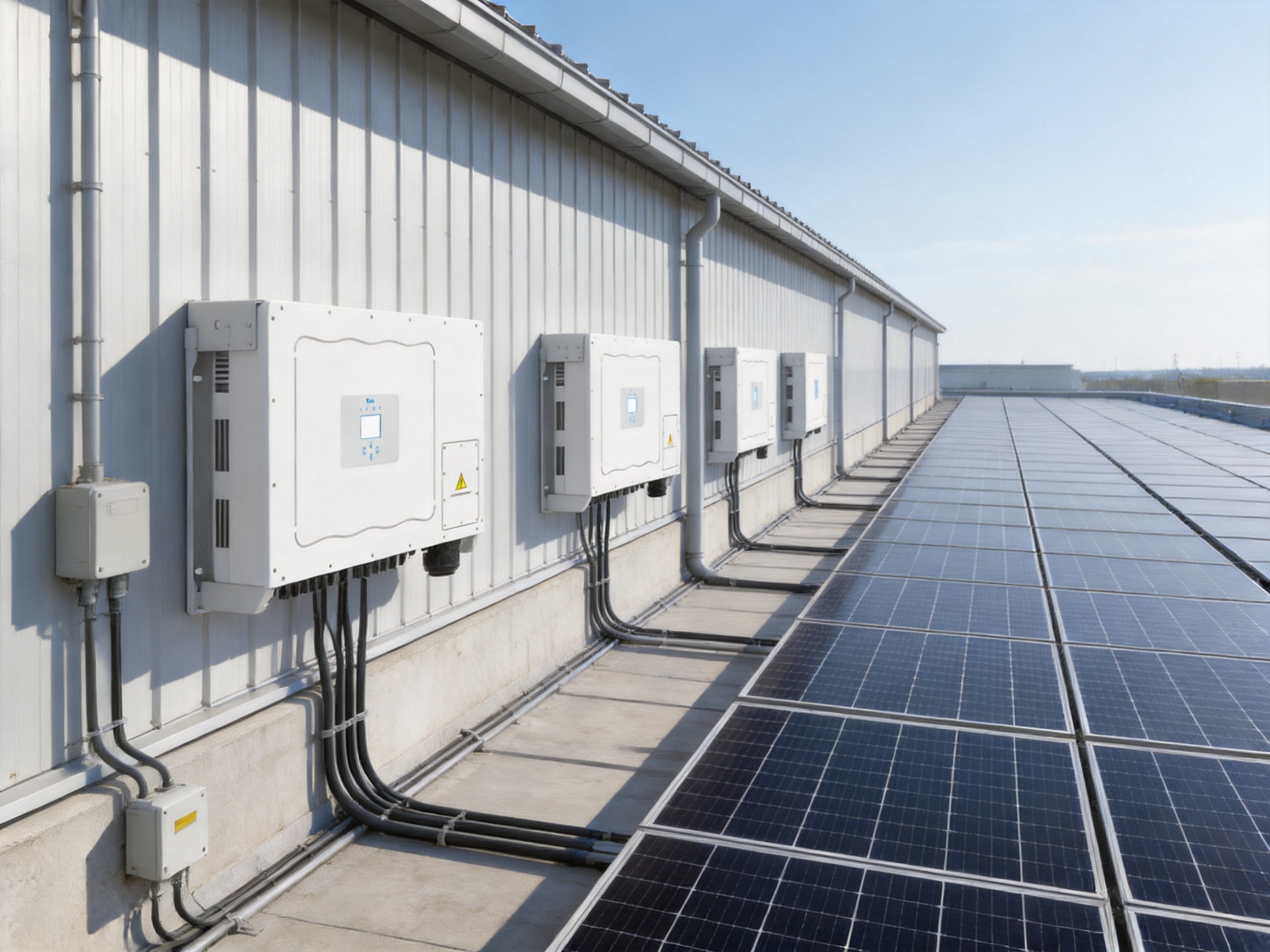
The inverter has an IP65 ingress protection rating. This rating indicates protection against dust ingress and water jets from specified directions, making the enclosure suitable for many outdoor commercial installations when installed according to the manufacturer’s instructions.
The operating temperature range is specified from -25°C to +60°C, with derating above 45°C. Thermal derating is a normal characteristic of high-power electronic equipment. As ambient temperature rises, the inverter may reduce output power to maintain safe internal component temperatures. Project designers should account for ventilation, solar exposure, mounting clearances, local climate, and the possibility of high-temperature operation.
Intelligent air cooling is used to manage heat. The cooling system is designed to adjust operation according to thermal demand rather than operating at a constant maximum level under all conditions. The listed noise level is no more than 55 dB, which may be appropriate for many industrial and commercial environments, subject to the location and local noise requirements.
The inverter is specified for operation at altitudes up to 4,000 meters and permissible ambient humidity from 0% to 100%. These capabilities broaden the potential application range, although installation conditions such as condensation, salt exposure, corrosive atmospheres, dust concentration, and direct weather exposure must still be evaluated.
The cabinet dimensions are approximately 824 mm wide, 516 mm high, and 312.7 mm deep, excluding connectors and brackets. The listed weight is 81 kg. Because this is a substantial electrical device, installation planning should include suitable wall or structural support, lifting procedures, cable bending radius, maintenance access, and adequate spacing around ventilation areas.
8. Monitoring, Communications, and Service Visibility
Commercial PV owners need visibility into energy production, alarms, operating status, and system performance. The inverter provides RS485 and RS232 communication interfaces. Optional monitoring modes include GPRS, Wi-Fi, Bluetooth, 4G, and LAN.
Communication flexibility is useful because project conditions vary. A small commercial building may use a local network or Wi-Fi, while a remote ground-mounted installation may require cellular communication. RS485 remains valuable for stable wired connections over suitable distances and for linking multiple devices through a broader plant monitoring architecture.
String intelligent monitoring is listed as an optional function. String-level visibility can help maintenance teams identify underperforming circuits, blown fuses, loose connections, module degradation, shading problems, or abnormal current behavior. Without string monitoring, the operator may see only the total inverter output and need additional testing to isolate a fault.
Monitoring data can support several operational activities:
• Verification of expected daily energy production.
• Comparison of inverter performance across a site.
• Early detection of abnormal string behavior.
• Historical analysis of seasonal generation.
• Maintenance scheduling based on actual alarms.
• Confirmation of zero-export performance.
• Documentation for asset owners and operators.
The Deye product ecosystem also includes the Deye Cloud App and energy IoT solutions. These wider digital capabilities can help connect inverter data with monitoring and energy management services, although the exact functions available depend on the selected communication hardware and software configuration.
9. Advantages Compared with Conventional Competitor Approaches
When comparing high-power string inverters, it is important to evaluate the complete system value rather than one specification. The SUN-(70-110)K-G03 series offers several practical advantages over conventional approaches that use fewer trackers, separate protection equipment, limited monitoring, or a narrower product range.
9.1 More MPPT Channels for Complex Roofs
Many commercial sites have multiple roof orientations, obstructions, skylights, parapets, and shading patterns. A lower-MPPT inverter can force designers to combine strings with different operating characteristics. The six-MPPT architecture provides more independent tracking points and can reduce the electrical compromises associated with irregular array layouts.
9.2 High Power Without a Centralized Conversion Dependency
Central inverters can be effective in utility-scale projects, but a single conversion unit creates a concentrated point of failure. A distributed string inverter design divides the conversion task among multiple units. If one inverter requires service, the remainder of the plant can continue operating. This can improve operational resilience and make replacement or maintenance more manageable.
9.3 Integrated Protection
The inclusion of DC and AC Type II surge protection, anti-islanding protection, residual current detection, insulation monitoring, and a DC switch can simplify equipment coordination. Fewer separate components may reduce design complexity, enclosure requirements, and installation labor, subject to local electrical rules.
9.4 Broad Model Continuity
The six power ratings are based on a common platform. This is advantageous for installers that manage multiple projects or owners that may expand a site over time. Familiar commissioning procedures, similar enclosure arrangements, and a consistent communication environment can reduce training and spare-parts complexity.
9.5 Advanced Grid Interaction
Zero-export and VSG capabilities provide greater flexibility than a basic grid-following inverter that only delivers active power. These functions support projects with export limitations, grid-support requirements, or energy management objectives.
9.6 Commercially Relevant Environmental Rating
The IP65 enclosure, -25°C to +60°C operating range, 4,000-meter altitude rating, and intelligent air cooling support a wide range of installation conditions. The actual suitability of a site still requires engineering review, but the stated specifications make the platform appropriate for many outdoor commercial settings.
9.7 Optional Monitoring Depth
Not every project requires the same monitoring investment. Optional string intelligent monitoring and multiple communication methods allow the system to be configured according to the site’s operational priorities and budget. This can be more practical than requiring every project to purchase an identical monitoring package.
10. Manufacturing and Engineering Strengths
Product performance is influenced not only by circuit design but also by the quality of research, manufacturing control, testing, supply-chain coordination, and after-sales support. Ningbo Deye Inverter Technology Co., Ltd. describes itself as a comprehensive technology manufacturing enterprise integrating research and development, design, production, sales, and service.
This integrated structure can support closer coordination between engineering and production. Feedback from field applications can be used to improve product design, firmware, service procedures, and manufacturing controls. At the same time, a broad product portfolio allows the company to develop experience across residential, commercial, industrial, and utility applications.
The company’s inverter product line includes string inverters from 1 kW to 136 kW, energy storage inverters from 3 kW to 80 kW, and microinverters from 300 W to 2.2 kW. It also offers commercial and industrial energy storage cabinets, modular energy storage systems, residential all-in-one ESS products, PV-battery-EV charging solutions, and utility-scale liquid-cooled energy storage systems.
This breadth is relevant to the SUN-(70-110)K-G03 because modern solar projects increasingly combine PV generation with energy storage, electric vehicle charging, load management, and export control. A manufacturer with products across these categories can provide a more coordinated technical ecosystem than a supplier focused only on one inverter type.
The company states that it serves more than 140 countries and regions. International market experience can contribute to familiarity with different grid environments, certification requirements, installation practices, and climate conditions. The product documentation lists a wide range of grid regulations and safety or EMC standards, reflecting the need to adapt equipment for multiple markets.
Advanced manufacturing should be understood as a complete process rather than a single production claim. For a high-power inverter, important manufacturing strengths include:
• Consistent assembly of high-current DC and AC terminals.
• Controlled production of power electronic modules and cooling interfaces.
• Reliable installation of control boards, sensors, and communication components.
• Verification of protective functions and insulation performance.
• Software and firmware configuration appropriate to the destination market.
• Traceability of production batches and critical components.
• Inspection of enclosure sealing and mechanical assembly.
• Testing of electrical performance before shipment.
The supplied product information confirms the company’s integrated R&D and production model, international product scope, and certification-oriented development. Specific factory test procedures, automation levels, component suppliers, and production-line details should be confirmed through the manufacturer’s current technical and quality documentation.
11. Standards, Certification, and Market Readiness
Commercial solar equipment must comply with electrical safety, electromagnetic compatibility, and grid connection requirements. The listed grid regulations include European, South African, Australian, Italian, German, Spanish, Polish, and other market-related requirements. The safety and EMC references include IEC/EN 61000-6-1/2/3/4, IEC/EN 62109-1, and IEC/EN 62109-2.
These references cover different aspects of equipment behavior. IEC 62109 standards relate to safety requirements for power converters used in photovoltaic systems. IEC 61000 series standards address electromagnetic compatibility. Grid standards such as IEC 61727 and IEC 62116 address utility interaction and anti-islanding behavior, while national standards specify additional connection requirements.
The product documentation also references certificates associated with EN 50549, VDE-AR-N 4105, CEI 0-21, NRS 097, IEC 61727, IEC 62116, IEC 61683, IEC 60068, and other requirements. Project developers should obtain the current certificate for the exact model and market. A general family reference does not automatically replace a local approval or utility acceptance process.
Compliance documentation can simplify project approval, but installation quality remains equally important. Incorrect grounding, undersized conductors, poor surge protection coordination, unsuitable breakers, inadequate ventilation, or improper grid settings can affect system safety and performance even when the inverter itself is certified.
12. Installation and System Design Considerations
A successful installation begins with correct electrical design. The PV string voltage must remain within the specified maximum input voltage under the coldest conditions, and the operating voltage should remain within the MPPT range during typical operation. String current must also remain within the maximum operating input current and short-circuit current limits.
The models specify maximum input short-circuit current arrangements of either 60+60+60+60 A or 60+60+60+60+60+60 A, and maximum operating PV input current arrangements of either 40+40+40+40 A or 40+40+40+40+40+40 A. These values should be matched to the number of strings connected to each MPPT and to the electrical characteristics of the selected PV modules.
On the AC side, rated output current varies by model and voltage condition. For example, the 70 kW model is listed with rated currents of 106.1/101.5 A, while the 110 kW model is listed with 166.7/159.4 A. Maximum AC output currents are higher. Cable sizing, overcurrent protection, isolation, voltage drop, and switchgear selection must be based on the applicable current, installation method, ambient conditions, and local code.
The grid connection form is 3L+N+PE. This should be coordinated with the site distribution system and transformer arrangement. The inverter’s power factor capability may require specific reactive power settings, particularly where the utility requires a defined power factor or voltage response.
Mechanical installation is also important. The inverter should have adequate clearance for air circulation and service access. Direct exposure to extreme solar heating may increase thermal derating. Locations with corrosive chemicals, salt mist, excessive dust, or standing water require additional assessment. The enclosure rating does not mean the inverter can be installed without regard to environmental conditions.
Commissioning should include verification of polarity, insulation resistance, grounding, communication, grid voltage, frequency, phase sequence, protection settings, and export-control behavior. The exact procedure should follow the current manual and local regulations.
13. Typical Commercial and Industrial Applications
The SUN-(70-110)K-G03 family can be applied to a variety of commercial and industrial solar projects.
13.1 Factory and Warehouse Rooftops
Factories and warehouses often have large roof areas but multiple sections with different orientations. Six MPPT channels can help divide the array according to roof geometry. High AC power allows fewer inverter units for a given plant size, while string architecture maintains distributed conversion.
13.2 Retail and Office Buildings
Retail centers and office buildings may have strict export limitations because the local connection is sized primarily for building consumption. Zero-export functionality can help align PV production with on-site loads and avoid unwanted reverse power flow.
13.3 Agricultural and Commercial Facilities
Agricultural facilities may combine barns, processing buildings, cold storage, pumps, and other loads. The wide operating range, outdoor enclosure, and multiple tracker configuration can help accommodate a distributed array across several structures.
13.4 Ground-Mounted Distributed Generation
Small and medium ground-mounted projects can use multiple high-power string inverters to divide the plant into manageable blocks. The distributed arrangement can simplify fault isolation and support staged construction.
13.5 Solar Systems Prepared for Energy Storage
Projects that may later add batteries or energy management can benefit from an inverter platform that supports zero-export control, communications, and a wider ecosystem of storage products. The inverter does not itself replace a battery inverter, but it can form part of a coordinated PV and ESS design.
14. Maintenance and Lifecycle Value
Lifecycle cost is determined by more than the initial purchase price. It includes energy yield, downtime, inspection labor, replacement components, monitoring, service response, and the ability to expand or modify the system. The product’s optional string monitoring can reduce the time needed to identify an underperforming circuit.
Preventive maintenance should include inspection of terminals, cable entries, enclosure condition, ventilation openings, cooling components, communication connections, and surge protection indicators where provided. Operators should review alarms and production trends rather than waiting for a complete failure.
The listed standard warranty is five years. Warranty conditions, extensions, exclusions, response procedures, and regional service arrangements should be confirmed before procurement. Because the company provides products across PV, ESS, and energy management categories, customers may also be able to coordinate technical support across more than one part of a broader energy system.
A distributed string architecture can provide lifecycle advantages because a fault in one inverter affects only a portion of the plant. Spare-unit planning can also be more straightforward than maintaining a single specialized central inverter, although the final decision depends on the plant size, logistics, and service agreement.

15. Technical Specification Summary
| Specification | Value or Range |
|---|---|
| Product family | SUN-70/75/80/90/100/110K-G03 |
| Topology | Non-isolated |
| Rated AC power | 70–110 kW |
| Maximum AC apparent power | 77–121 kVA |
| Maximum PV input voltage | 1,000 V |
| Start-up voltage | 250 V |
| MPPT voltage range | 200–850 V |
| Rated PV input voltage | 600 V |
| Maximum number of MPPT trackers | 6 |
| Maximum efficiency | Up to 98.8% |
| MPPT efficiency | Greater than 99% |
| Power factor range | 0.8 leading to 0.8 lagging |
| Total current harmonic distortion | Less than 3% |
| Grid connection | 3L+N+PE |
| Surge protection | Type II DC and Type II AC |
| Communication interfaces | RS485 and RS232 |
| Optional monitoring | GPRS, Wi-Fi, Bluetooth, 4G, LAN, string monitoring |
| Operating temperature | -25°C to +60°C, derating above 45°C |
| Ingress protection | IP65 |
| Maximum altitude | 4,000 m |
| Cooling | Intelligent air cooling |
| Noise level | ≤55 dB |
| Dimensions | 824 × 516 × 312.7 mm, excluding connectors and brackets |
| Weight | 81 kg |
| Standard warranty | 5 years |
16. Frequently Asked Questions
What type of inverter is the SUN-(70-110)K-G03?
It is a three-phase grid-connected string inverter family for commercial and industrial photovoltaic systems. The family includes models rated from 70 kW to 110 kW.
How many MPPT trackers are available?
The family supports up to six MPPT trackers. The listed configurations include four-MPPT and six-MPPT arrangements, with up to four strings per tracker according to the model configuration.
What is the maximum PV input voltage?
The maximum PV input voltage is 1,000 V. String design must also consider the 200–850 V MPPT range, the 250 V start-up voltage, and module voltage changes caused by temperature.
What is the maximum efficiency?
The maximum efficiency is up to 98.8%. The supplied data lists maximum efficiency values of 98.70% and 98.80% for the model groupings. Actual performance depends on operating voltage, load, temperature, installation conditions, and model.
Can the inverter be used for zero-export projects?
Yes. Zero-export application is listed as a product feature. A complete zero-export installation requires suitable metering, control equipment, communications, and correct commissioning.
Does the inverter support reactive power control?
Yes. The stated power factor adjustment range is 0.8 leading to 0.8 lagging. The final settings must follow the requirements of the utility and the project’s grid-connection agreement.
What protections are built into the inverter?
Protection functions include DC reverse polarity protection, AC overcurrent and overvoltage protection, short-circuit protection, thermal protection, insulation impedance detection, DC component monitoring, anti-islanding protection, residual current detection, DC and AC Type II surge protection, and a DC switch. AFCI is available as an optional function.
Is string-level monitoring included as standard?
String intelligent monitoring is listed as optional. The project should specify the required monitoring functions and communication equipment during procurement.
Can the inverter be installed outdoors?
Yes. The inverter has an IP65 rating and an operating temperature range of -25°C to +60°C, with derating above 45°C. Installation must still provide suitable ventilation, structural support, service access, and protection from unsuitable environmental conditions.
What communication options are available?
The inverter provides RS485 and RS232 interfaces. Optional monitoring modes include GPRS, Wi-Fi, Bluetooth, 4G, and LAN.
What is VSG operation?
VSG means virtual synchronous generator operation. It is a grid-support function designed to provide certain controlled behaviors associated with synchronous generation. Its use depends on the grid code, firmware, system design, and commissioning requirements.
What is the standard warranty period?
The listed standard warranty is five years. Customers should confirm regional warranty terms, extension options, service conditions, and exclusions before placing an order.
Is the series suitable for energy storage projects?
It can form part of a PV and energy storage system, particularly where zero-export control, communications, and coordinated energy management are required. The inverter itself is a PV string inverter, so a compatible battery inverter or ESS architecture must be selected separately.
17. Conclusion
The SUN-70/75/80/90/100/110K-G03 series is designed as a flexible, high-power three-phase string inverter platform for commercial and industrial solar generation. Its primary strengths are the broad 70–110 kW power range, up to six MPPT trackers, wide PV voltage window, high conversion efficiency, advanced grid functions, integrated protection, optional string monitoring, and outdoor-ready construction.
Compared with less flexible high-power inverter approaches, the series can simplify array design on complex roofs, reduce dependence on a single centralized conversion unit, support export-limited projects, and provide more detailed operational visibility. Its power factor control, low stated harmonic distortion, VSG application, and extensive grid-standard references further support use in modern distribution networks.
The product is also supported by a manufacturer with integrated R&D, design, production, sales, and service capabilities and a broad portfolio spanning photovoltaic inverters, microinverters, energy storage, EV charging, and energy management. This wider manufacturing and technology base is valuable as commercial solar projects become increasingly connected to batteries, flexible loads, and digital monitoring platforms.
For project owners and installers, the best results will come from matching the selected model to the array design, climate, grid requirements, monitoring objectives, and future expansion plans. When correctly engineered and commissioned, the SUN-(70-110)K-G03 platform provides a strong combination of power density, design flexibility, grid compatibility, and lifecycle serviceability for modern commercial PV systems.
References
1. SUN-(70-110)K-G03 Product Datasheet, Ningbo Deye Inverter Technology Co., Ltd.
2. SUN-(70-110)K-G03 Installation and Operation Manual, Ningbo Deye Inverter Technology Co., Ltd.
3. IEC 62109-1 and IEC 62109-2, Safety of Power Converters for Use in Photovoltaic Power Systems.
4. IEC 61727, Photovoltaic Systems: Utility Interface Characteristics.
5. IEC 62116, Utility-Interconnected Photovoltaic Inverters: Test Procedure of Islanding Prevention Measures.
6. IEC 61000 Series, Electromagnetic Compatibility Requirements.
7. EN 50549 Series, Requirements for Generators Connected in Parallel with Distribution Networks.
8. VDE-AR-N 4105, Power-Generating Plants on the Low-Voltage Grid.
9. CEI 0-21, Technical Rules for Connection of Active and Passive Users to Low-Voltage Utility Networks.
10. Manufacturer product and company information supplied for the SUN-(70-110)K-G03 series.
Product: SUN-70/75/80/90/100/110K-G03

PREV:Three-Phase String Inverter Technology for Reliable, Flexible Solar Power Systems
NEXT:High-Voltage Three-Phase Hybrid Inverter for Scalable Solar Energy Storage
Share
Product recommendations
news recommendations
-
 From Centralized Grids to Virtual Power Plants: The Next Evolution of the Power System
For more than a century, power systems around the world have relied on a centralized model. Large p...
-
 GLOBAL EXHIBITION TIMELINE
*Click to view larger image
-
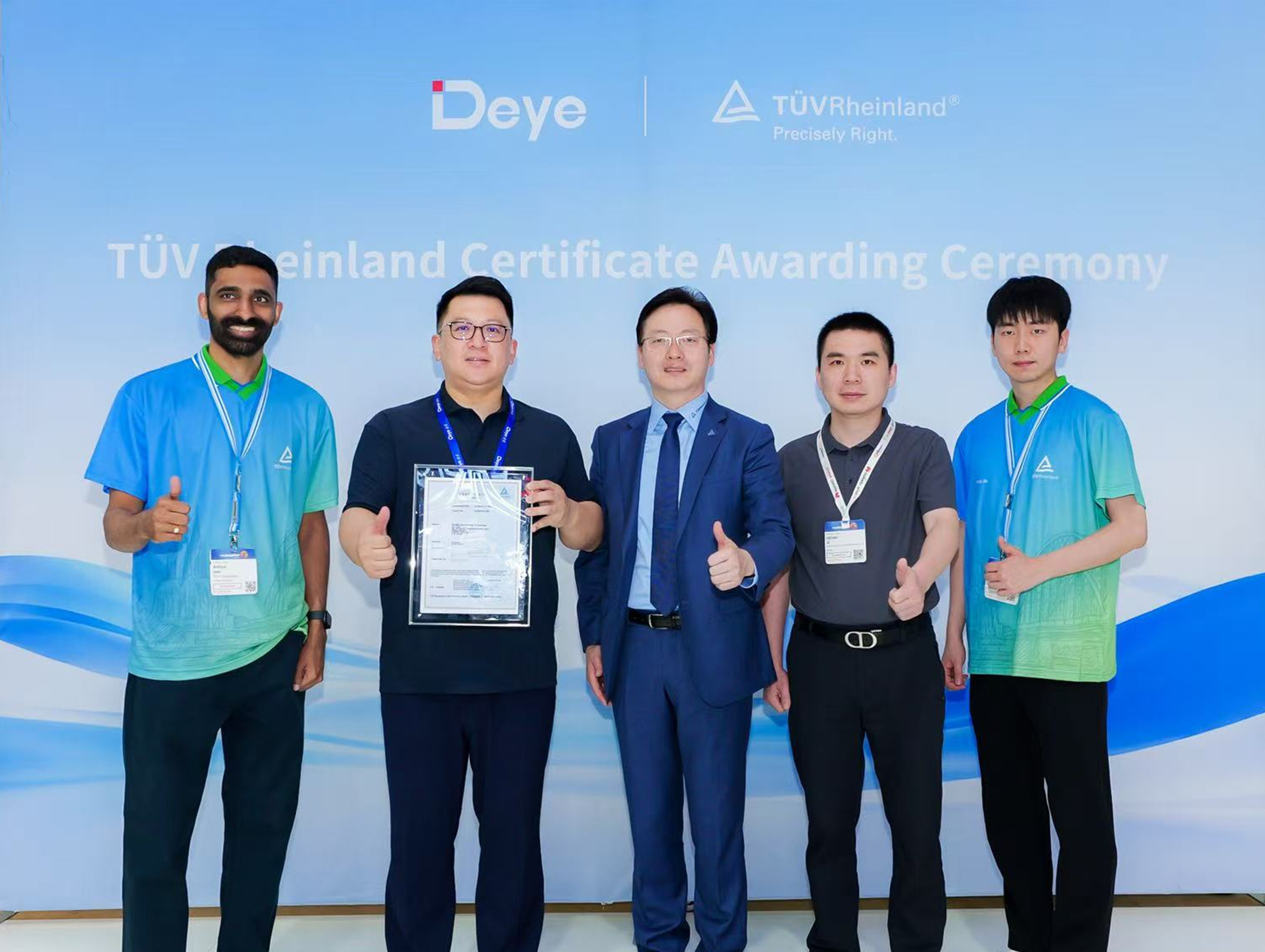 Deye Secures Multiple TÜV Rheinland Certifications at The smarter E Europe
On June 23, the opening day of The smarter E Europe 2026, Deye was officially awarded several presti...

Copyright@ 2024.Ningbo Deye Inverter Technology Co.,Ltd. All rights reserved. Solar Inverter Manufacturer
